How Commercial Real Estate Firms Track Deals & Teams at Scale
Commercial real estate teams juggle dozens of properties, agents, and stakeholders across multiple deal stages. See how AI-native systems replace spreadsheets and manual workflows.

The Commercial Real Estate Complexity Problem
Commercial real estate (CRE) is a high-touch, high-stakes business. Your team manages:
- Multiple deal pipelines — acquisitions, dispositions, leasing, development
- Distributed stakeholders — brokers, lenders, attorneys, property managers, investors
- Complex workflows — due diligence, underwriting, lease negotiation, compliance tracking
- Fragmented data — property details scattered across email, shared drives, and individual spreadsheets
Traditional CRM systems were built for sales teams closing deals in weeks. They don't map to the 6–18 month deal cycles, the legal complexity, or the multi-party coordination that CRE demands.
Why mCoreBrain Fits CRE Better
Prompt-native architecture changes everything. Instead of forcing your CRE workflow into pre-built templates, you describe your business in plain language:
"We track properties with addresses, zoning details, and cap rates. Each property has multiple deal opportunities (buy, sell, lease). Deals move through stages: pipeline, underwriting, legal review, closing. We track all documents, LOIs, and communications by deal. Our lenders need read-only access to underwriting docs. Our property managers see only the properties they manage."
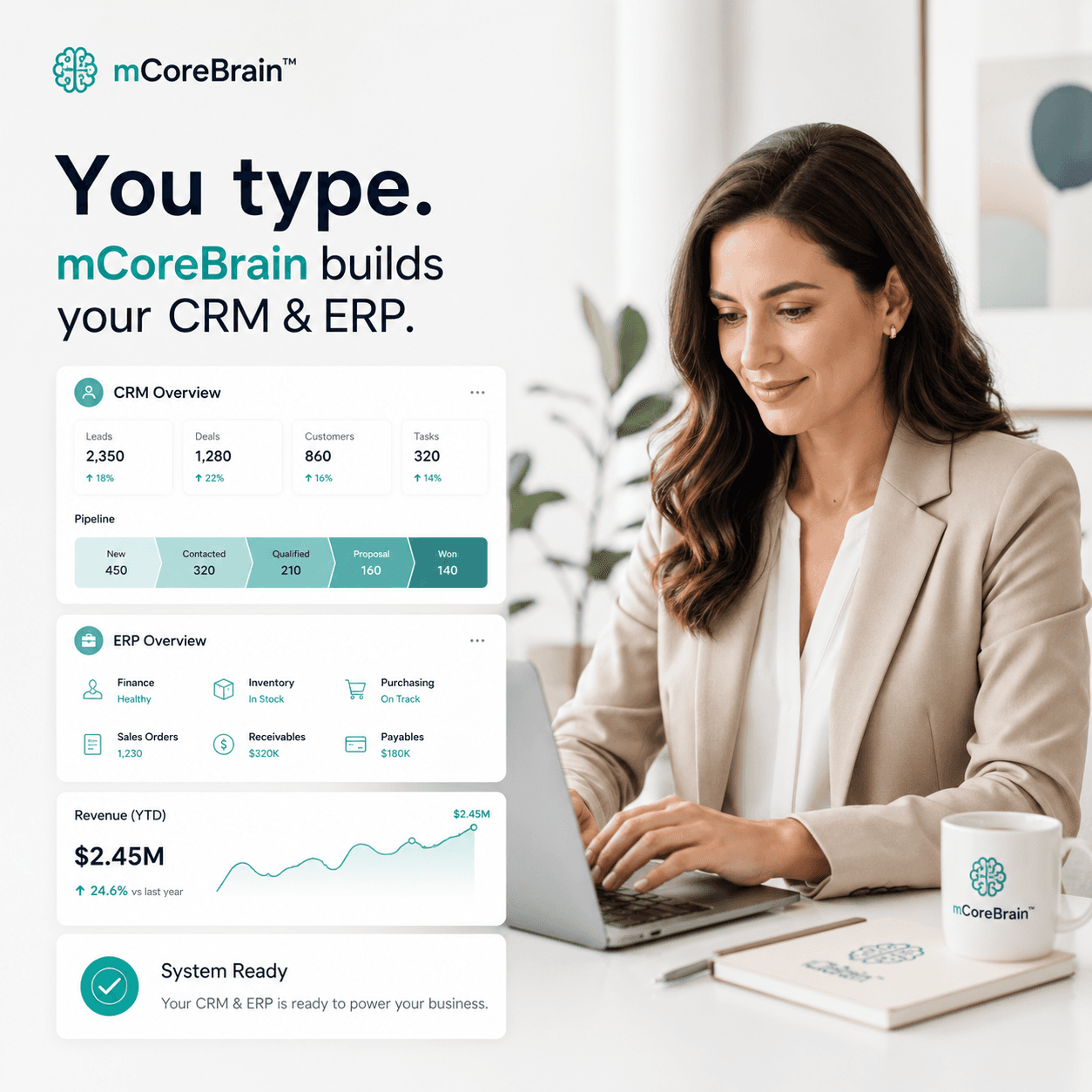
mCoreBrain generates your complete system in minutes — all fields, pipelines, workflows, roles, and permissions baked in. No consultant translation layer. No custom dev.
What CRE Teams Actually Build
Property Management Hub
- Address, size, zoning, tenant info, lease terms, expense tracking
- Linked to every deal involving that property
- Automatic permissions: property managers see only their buildings
Multi-Stage Deal Pipeline
- Pipeline → Underwriting → Legal → Closing → Post-Closing
- Customizable fields per stage (LOI date, appraisal value, lender status, earnest money)
- Automated handoffs (legal review triggers a workflow to notify attorneys)
- Historical deal tracking for pipeline forecasting
Document Repository
- All docs attached to deals (LOIs, appraisals, title reports, leases)
- Organized by deal stage with version control
- Role-based access (lenders see financials; agents see marketing materials)
Team & Stakeholder Visibility
- Brokers, lenders, attorneys added as external users with scoped access
- Real-time updates on deal status without email chains
- Task assignments with deadline tracking
Investor Reporting
- Automatic dashboards: portfolio by asset type, total committed capital, pipeline value, deal stage breakdown
- One click: deploy a read-only investor portal
Real Workflow: How It Moves
- Agent identifies a property → Creates record with all details (address, price, sector, investor interest)
- Prospect moves to underwriting → System auto-assigns to underwriting team, triggers checklist (appraisal, environmental, title)
- Documents land in Slack/email → Team uploads them to the deal; mCoreBrain auto-links by stage
- Lender review starts → External lender invited; sees only financial docs and underwriting status
- Legal requests info → Workflow notification sent; attorney sees deed, title report, lease summaries
- Deal closes → Status updates to "Closed"; property shifts to management view; closing documents archived
- Weekly pipeline report → Dashboard auto-refreshes: $150M in closings, $80M in legal, $200M in underwriting
Why This Beats Spreadsheets + Salesforce
| Challenge | Old Approach | mCoreBrain |
|---|---|---|
| Deal complexity | Force-fit into generic sales pipeline | Model your actual CRE stages and dependencies |
| Multi-party access | Email attachments; version chaos | Role-based portal; version control; audit trail |
| Document tracking | Shared drive nightmare | Auto-linked to deal; stage-gated permissions |
| Lender/attorney coordination | Manual status calls | External users see live deal status on demand |
| Setup time | 6+ months implementation | Describe your workflow; deploy in days |
| Customization | Pay consultants $100K+ | Modify in natural language; AI regenerates instantly |
The Real Win: Speed & Accuracy
When a deal hits legal review, someone doesn't have to manually move a card. When an investor asks for a portfolio report, they don't get a 2-week-old Excel file. When a lender wants to know if due diligence is on track, they log in and see it themselves.
Your team spends time on deals, not on keeping systems in sync.
Most CRE firms start with one office managing 10–15 deals. By year three, they're multi-city with 50+ concurrent deals. At that scale, manual workflows don't just slow you down — they create risk.
Next Steps
If your firm is still managing CRE deals in Salesforce, Pipedrive, or spreadsheets, it's time to see what prompt-native infrastructure can do.
Visit mcorebrain.org to describe your CRE workflow and see your system auto-generated in real time. No credit card, no sales call — just a live demo of how AI-native business software actually works for complex, multi-party deal environments.