How Consulting Firms Win & Deliver Without Tool Sprawl
Consulting firms juggle proposals, project delivery, resource allocation, and billing across disconnected tools. mCoreBrain unifies the entire workflow—from lead to invoice—in one AI-native platform.
The Consulting Firm Challenge: Fragmented Tools, Fragmented Intelligence
Consulting firms live in a state of controlled chaos. Your team is tracking:
- Sales pipeline: Who are the active prospects? When do they close? What's the proposal status?
- Project delivery: Which consultants are on which engagements? Are we on scope, on budget, on timeline?
- Resource allocation: Can we staff the new RFP? Who has capacity next quarter?
- Billing & utilization: How many billable hours did each consultant log? Are we hitting margin targets?
- Client relationships: What's the renewal risk? When is the next review meeting?
Result: Account managers don't know project status. Project managers don't see pipeline risk. Finance can't forecast accurately. Decision-making is slow and based on outdated information.
Why Traditional CRM/ERP Fails Consulting Firms
Salesforce excels at pipeline management but treats projects as afterthoughts. You'll need additional tools for resource planning and utilization tracking.
Project management platforms (Asana, Monday, Smartsheet) are great at task execution but lack financial rigor and CRM integration. Billing is manual.
ERP systems (NetSuite, Deltek, Microsoft Dynamics) can handle financials and project costing, but onboarding takes 6–12 months and requires 3–5 custom integrations.
None of these platforms speak to each other without expensive middleware. Your data lives in silos. You end up with redundant data entry, conflicting versions of truth, and decision-making that lags reality by days or weeks.
How mCoreBrain Changes the Game
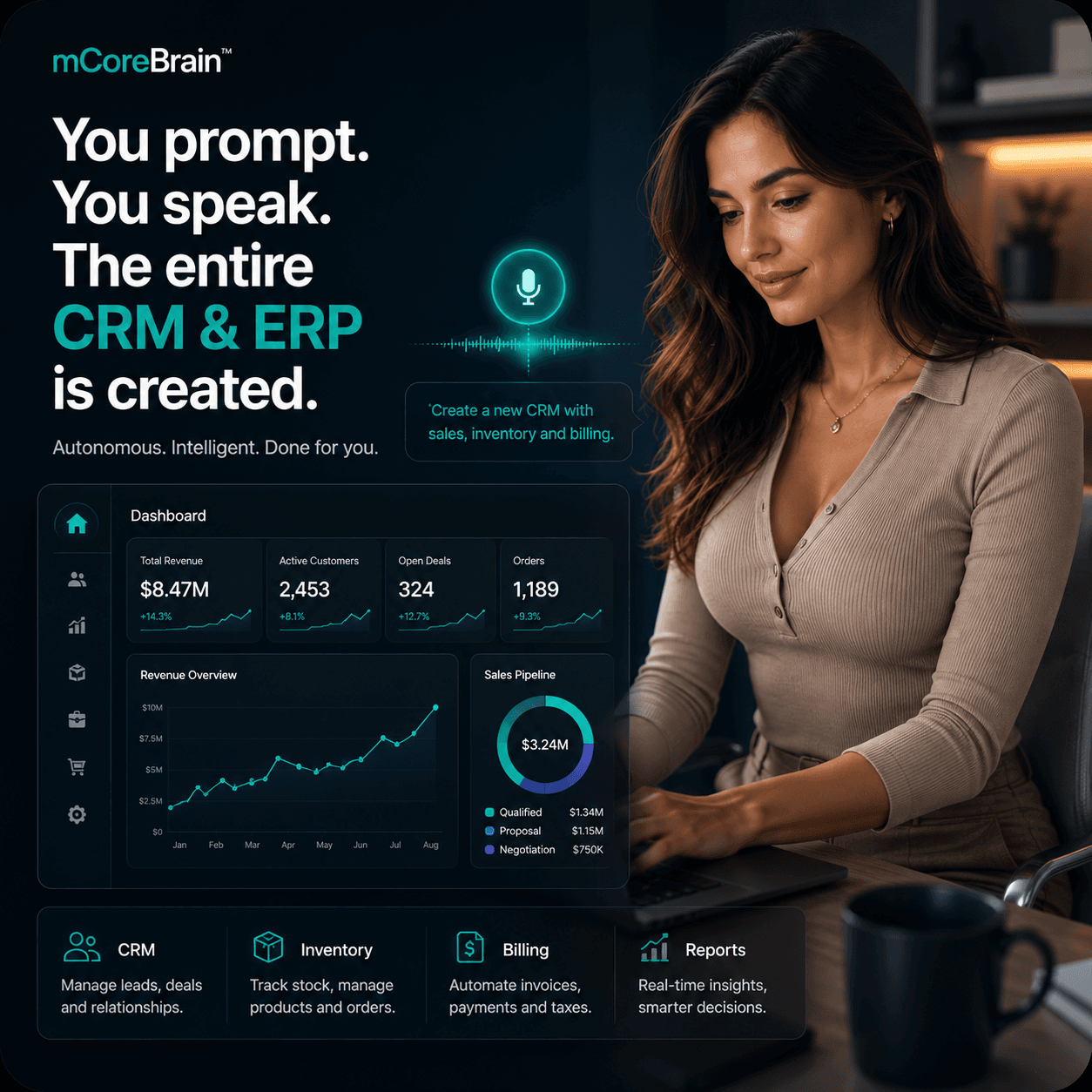
mCoreBrain is prompt-native: You describe your consulting business in plain language, and the AI generates your entire operating system—CRM, project management, resource planning, and billing workflows—in real time.
Here's what that looks like in practice:
1. One Source of Truth for Client & Opportunity Data
Your pipeline, active projects, and contract terms all live in one place. When a proposal closes, the project automatically inherits the client info, contract value, and resource requirements. No manual sync. No data re-entry.2. Integrated Resource Planning
You see consultant availability at a glance. When you win a new engagement, you can immediately assign resources, check utilization targets, and identify bench time. The system flags conflicts and suggests optimal staffing based on skill tags and prior projects.3. Real-Time Project & Financial Health
Project managers log hours, update scope changes, and flag risks—all within mCoreBrain. Finance automatically calculates margin, billable vs. non-billable time, and cost-to-date against budget. Reports update in real time.4. Governed Workflows for Admin & Business Users
mCoreBrain's two-layer architecture separates configuration (what you can do) from execution (what business users see and access). Your CFO configures billing rules once. Your PMs execute projects without worrying about financial compliance. Your junior consultants log time without seeing sensitive margin data.5. One-Click Production Deployment
No IT project. No 6-month implementation. You describe your firm, review the AI-generated system, and deploy to production when ready. Updates flow through AI-generated workflows, not custom code.Real-World Workflow: From RFP to Invoice
Day 1: Account manager receives RFP. Enters opportunity in mCoreBrain using a simple form. AI generates a proposal template based on similar past projects.
Day 4: Proposal wins. Finance team confirms contract terms (scope, rate card, timeline). Resource manager checks consultant availability.
Day 5: Project is created with auto-linked client, contract, and budget. Team is notified. Consultants begin logging hours against the project.
Week 4: Project manager updates scope change. mCoreBrain recalculates margin impact and flags it for approval. Finance is automatically notified.
Week 12: Project ends. Hours are locked. Invoicing workflow runs automatically. Client receives invoice with time summaries mapped to deliverables. Renewal opportunity is created based on contract end date.
Throughout: Dashboards show account health (active projects, utilization, upcoming renewals), pipeline (closed pipeline by month), and financial performance (margin by project, consultant utilization).
Why This Matters
Consulting firms compete on delivery quality, client relationships, and profitability. You can't do that with fragmented tools. You need systems designed for how consulting actually works: win → staff → deliver → bill → retain.
mCoreBrain is built for exactly that operating model. It reduces implementation time from months to days, lowers total cost of ownership by consolidating tools, and gives every stakeholder (sales, delivery, finance, leadership) the visibility they need to make fast, confident decisions.
Next Steps
If you're running a consulting firm and tired of toggling between five platforms, it's time to explore an AI-native alternative. Visit mCoreBrain.org to describe your business and see your personalized CRM/ERP system generated in real time. No credit card required. No sales call necessary unless you want one.