How Consulting Firms Deliver More Value Per Project
Consulting firms waste 30% of billable time on admin, proposals, and status updates. mCoreBrain eliminates that friction by letting consultants describe their workflow once—then deploying a custom CRM/ERP instantly.

The Consulting Firm's Hidden Cost Problem
Consulting is a people business. Your revenue comes from billable hours, deep client relationships, and the ability to staff projects efficiently. Yet most consulting firms run on a fragmented stack: a CRM for client management, a project tool for timelines, a resource planning spreadsheet, an accounting system, and email for everything else.
The result? Your senior consultants spend 3–4 hours a week hunting for information, updating status across systems, and answering "where are we on that proposal?" questions. Your ops team chases timesheets. Your finance team reconciles invoices manually. Your PMs watch deadlines slip because resource conflicts aren't visible until it's too late.
This isn't a technology problem—it's a system fragmentation problem. And traditional CRM/ERP solutions make it worse: they're generic, slow to deploy, require consultants you can't afford, and lock you into rigid workflows that don't match how consulting actually works.
What Consulting Firms Actually Need
Consulting has unique demands that off-the-shelf systems never quite solve:
- Resource visibility: Who's billable next week? Which consultants have bench time? Where are the skill gaps?
- Project profitability tracking: Real-time P&L by client, project, and engagement type—not a quarterly reconciliation.
- Proposal-to-delivery continuity: From initial pitch, through SOW, through delivery, to invoice and close—without re-entering data.
- Client asset management: Every engagement, deliverable, risk, and decision captured and searchable—for continuity and IP protection.
- Multi-office coordination: If you have multiple practice areas or geographies, staffing decisions need to be centralized but locally aware.
- Revenue recognition accuracy: Especially critical if you use subscription, retainer, or milestone-based billing models.
How mCoreBrain Changes the Game
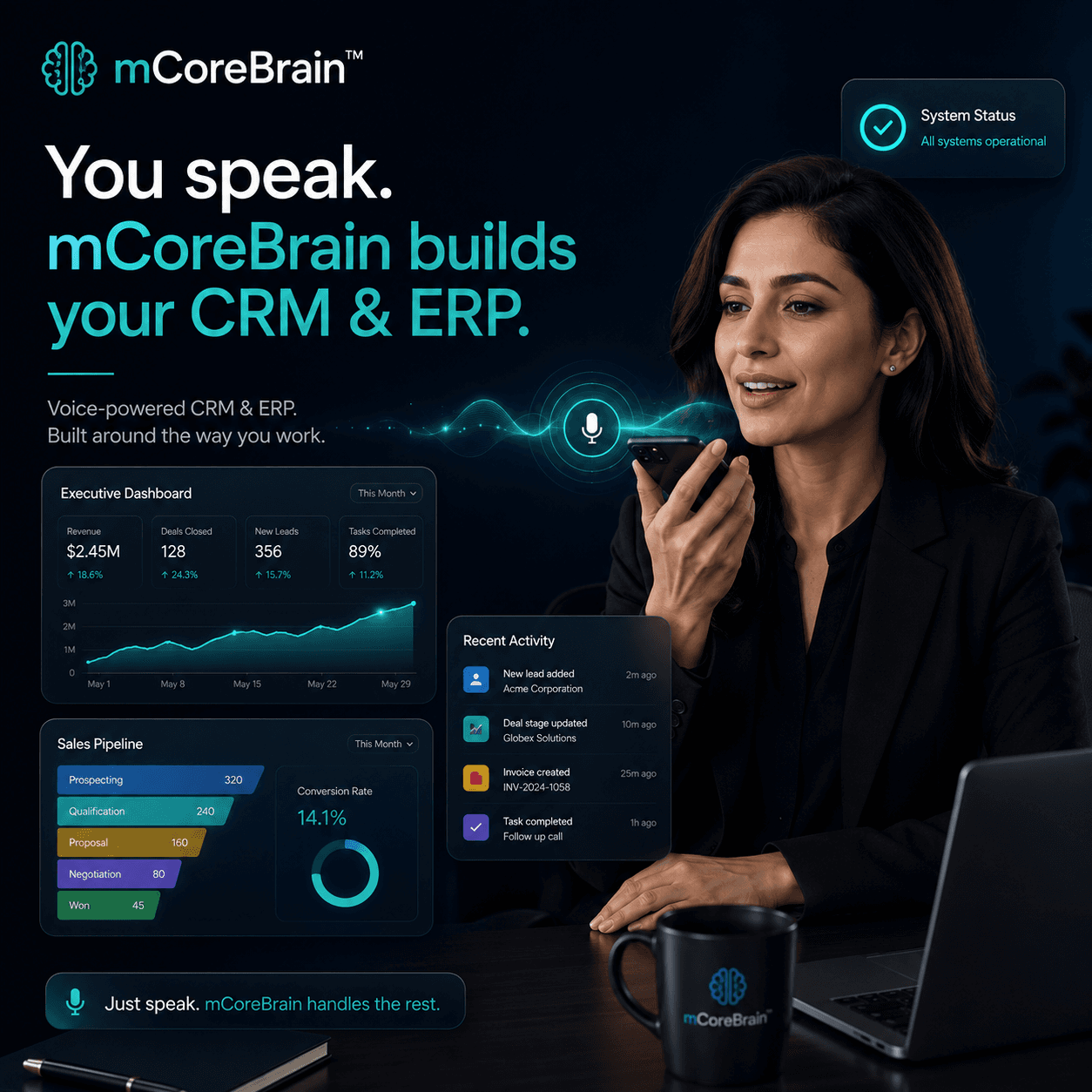
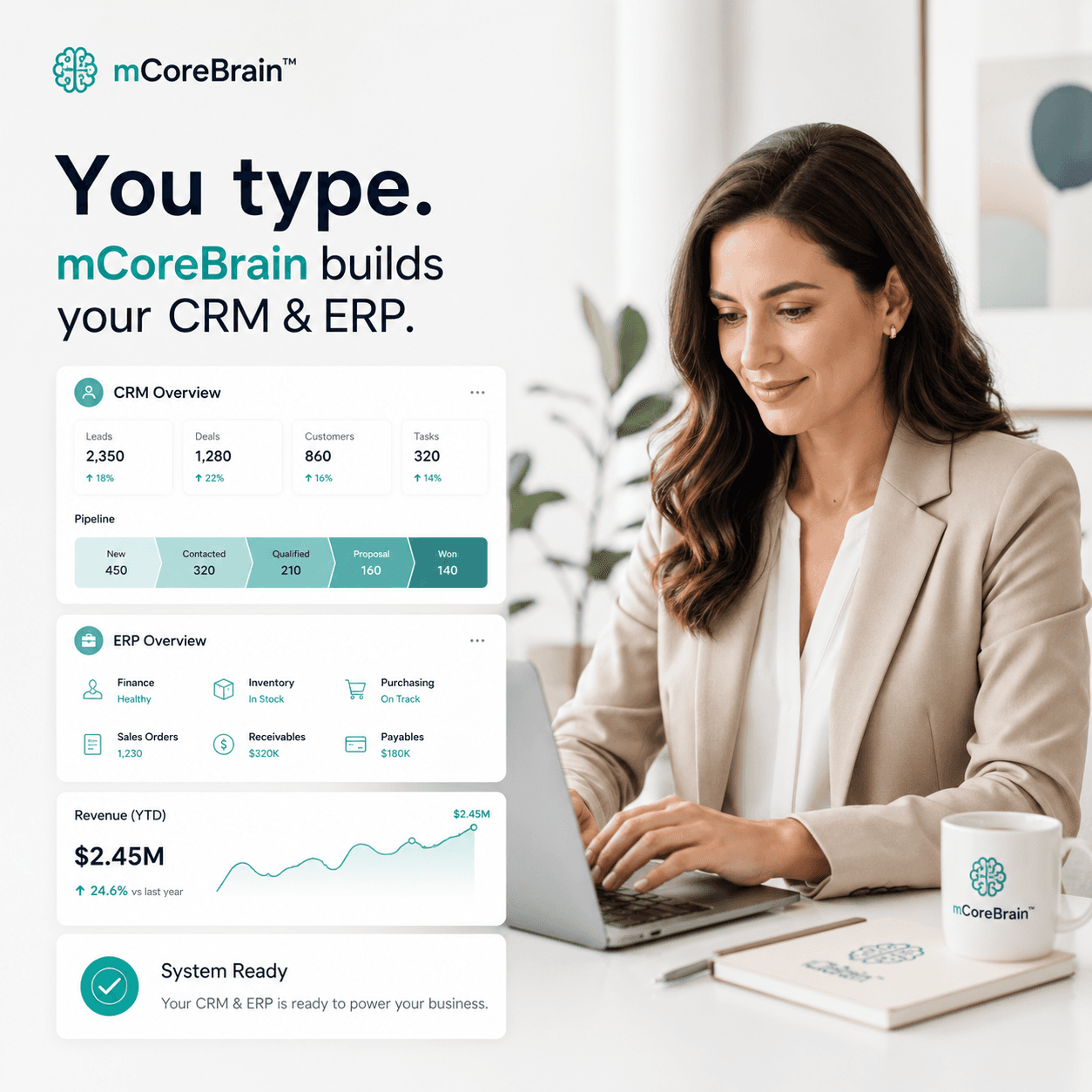
mCoreBrain is built for exactly this problem. Instead of you adapting to rigid software, you describe your consulting workflow in plain language. The AI generates a complete CRM/ERP tailored to your firm—with all the fields, pipelines, roles, and automations you need.
Here's what that looks like in practice:
1. Unified Project-to-Profit Pipeline
You describe how engagements flow: from business development → proposal → kick-off → delivery phases → closeout → invoicing. mCoreBrain generates the exact workflow, with custom fields for your methodology (agile sprints, waterfall phases, discovery weeks—whatever you use). Your PM sees real-time status. Finance auto-calculates revenue and margin by phase. No spreadsheets. No sync delays.2. Resource Planning That Actually Works
You define your consultant roles, skill levels, billable rates, and availability windows. mCoreBrain generates a resource registry that automatically flags conflicts, suggests optimal staffing for new proposals, and shows utilization by consultant, practice area, and client. Proposals go out with accurate delivery costs built in.3. Client Knowledge Base
Every engagement, conversation, deliverable, and lesson learned stays in one place. New team members joining a long-standing client engagement can read 18 months of context in 20 minutes. Compliance audits become trivial. IP is protected.4. Billing & Revenue Recognition
Your consulting model has its own billing rules: perhaps 50% upfront, 30% at milestone, 20% on delivery. Or retainer + variable. Or outcome-based. You describe it once; mCoreBrain automates it. Revenue is recognized correctly; invoices go out on time; cash flow is predictable.5. Deployment in Days, Not Months
No enterprise software rollout. No change management consultants. You sign up, describe your firm's operating model and key workflows, and deploy to production when you're ready. Roles cascade down so senior partners see firm-wide P&L while PMs see only their staffing and projects.The Real Benefit: Time Back
When your CRM and project and billing systems finally align, something remarkable happens: your people stop administrating and start consulting. Timesheets take 5 minutes, not 45. Status updates are automatic, not manual. Resource conflicts surface before they break a delivery. Proposals go out with accurate numbers. Invoices reflect actual delivery, so finance stops chasing consultants for clarification.
For a 50-person firm, that's roughly 400 hours a month returned to billable or strategic work. At $250/hour blended rate, that's $100k+ in reclaimed revenue—every month.
Next Steps
If your consulting firm runs on email, spreadsheets, and duct tape, it's time to consolidate. mCoreBrain isn't another tool to integrate; it's the one system that knows your business because you describe it.
Visit mcorebrain.org to see how other consulting firms have eliminated system chaos in weeks, not quarters. Describe your operating model, watch the CRM/ERP generate itself, and deploy when ready.