How Consulting Firms Scale Without Losing Control
Consulting firms face a unique challenge: growth demands process, but process kills the agility that makes them valuable. mCoreBrain solves this tension.
The Consulting Growth Trap
Consulting firms live in a paradox. When you're small, you're nimble—every project is custom, every client relationship is personal, and your team can communicate across a whiteboard. Processes feel like bureaucracy.
But the moment you scale, chaos creeps in. Project timelines slip. Resource allocation becomes a guessing game. Billable hours get lost in email threads. Client deliverables miss handoff deadlines. Your best people spend 40% of their week in status meetings instead of billable work.
Traditional CRM and ERP systems promised to solve this. But they forced you to choose: become a process-heavy machine, or stay chaotic. Most consulting firms end up limping between both states—rigid systems that don't match how consultants actually work, plus spreadsheets and Slack channels running parallel operations.
There's a third path. And it starts with prompt-native architecture.
What Consulting Firms Actually Need
Consulting businesses have specific operational demands that generic CRM/ERP systems struggle to handle:
- Custom project structures that vary by client and engagement type
- Resource capacity planning across multiple concurrent projects
- Time and expense tracking tied to project codes, not just entries in a database
- Milestone-based billing workflows that don't fit standard invoicing
- Proposal-to-delivery pipelines that are longer and more nuanced than typical sales cycles
- Subcontractor and partner management alongside your core team
- Knowledge retention across client engagements (so learnings compound)
How mCoreBrain Changes the Equation
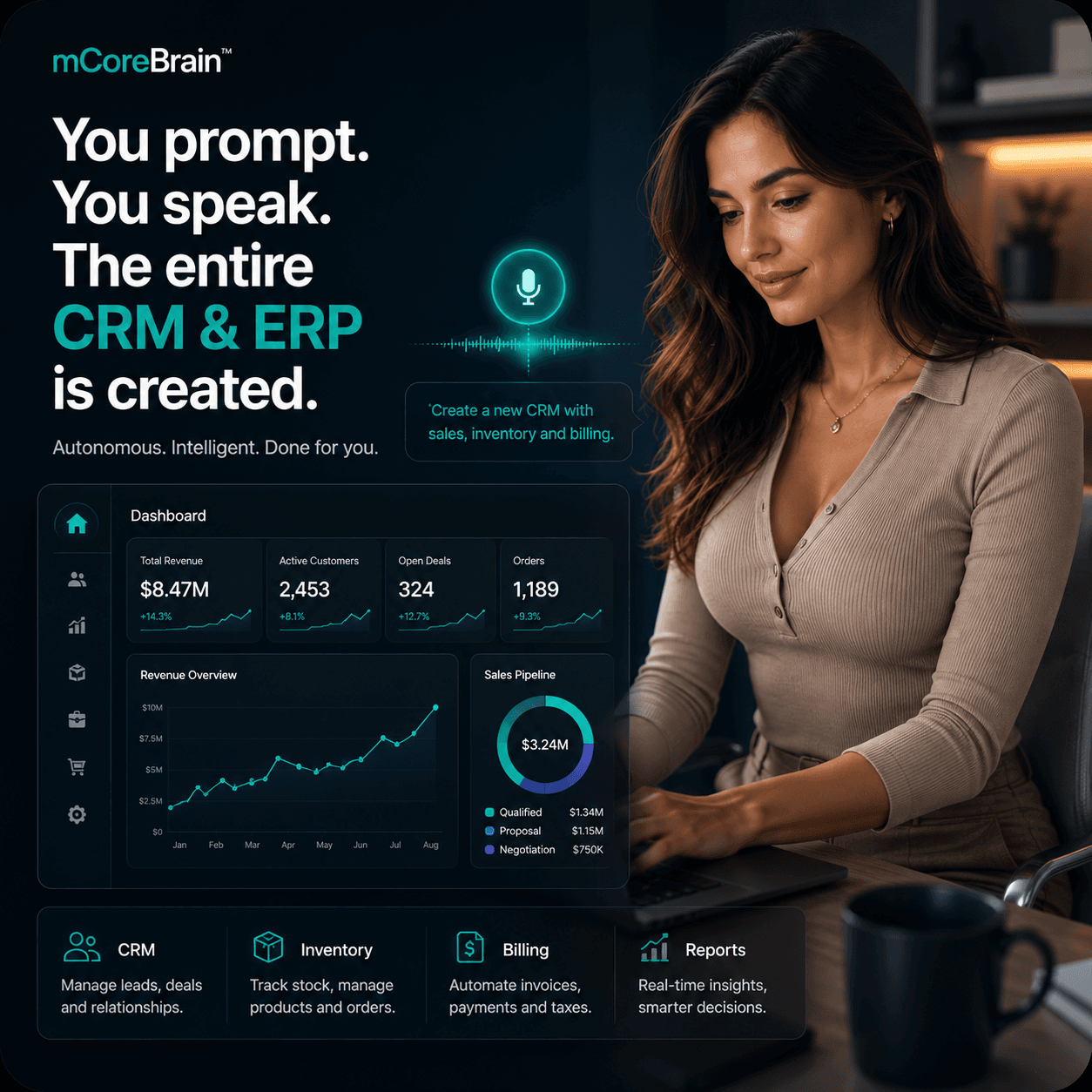
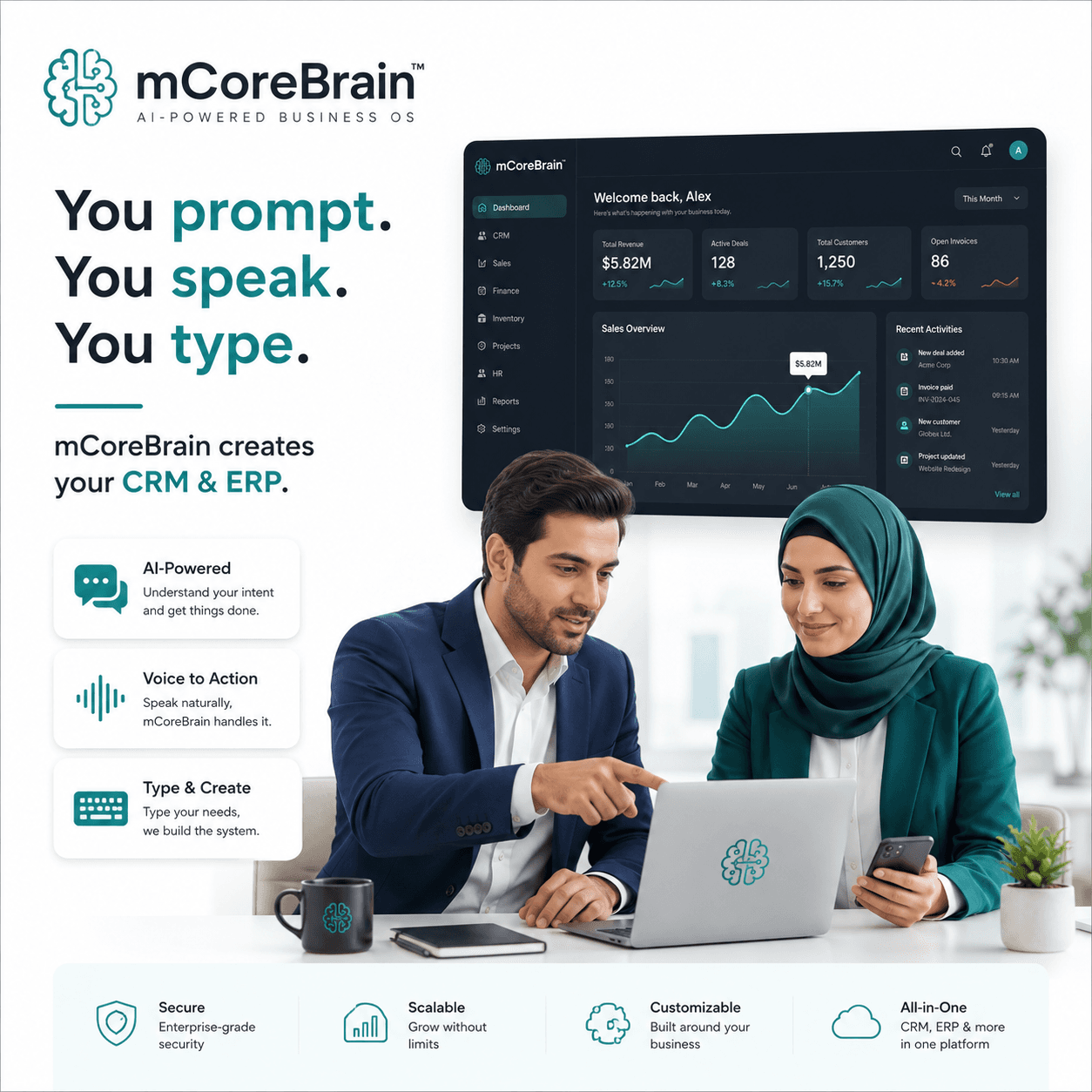
Instead of forcing your firm into a pre-built box, you describe your firm in plain language.
You tell mCoreBrain: "We run three types of engagements—fixed-price projects, time-and-materials, and retained retainers. Each has different billing rules and milestones. We have junior consultants, senior consultants, and partners. We need to track utilization by person and by project. When a project hits a milestone, it should auto-generate an invoice if the scope was met."
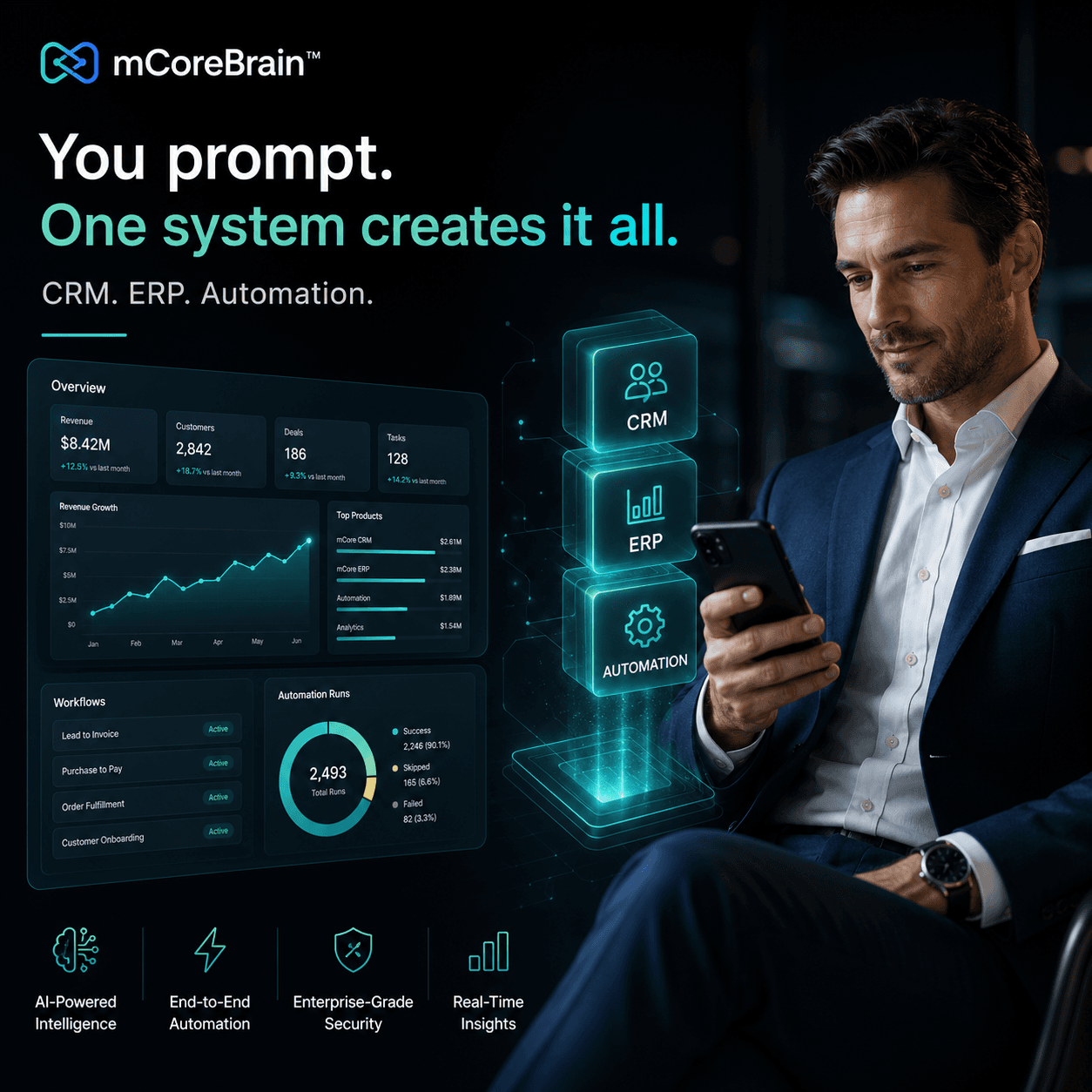
within minutes, mCoreBrain generates your complete system:
- Custom fields and modules for your engagement types, resource roles, and billing models
- Automated workflows that move projects through stages, flag resource conflicts, and trigger billing
- Role-based views so project managers see resourcing dashboards, finance sees invoicing pipelines, and partners see profitability by engagement
- Real-time visibility into utilization rates, project health, and cash flow
When your methodology evolves—say, you add a new engagement type or change how you bill retainers—you update the description, and the system adapts. You're not stuck re-configuring objects in a data model; you're describing your business, and the AI layer does the heavy lifting.
The Real Competitive Advantage
Consulting is fundamentally about scaling expertise without losing quality. Traditional systems approach this by adding process overhead, which slows you down. mCoreBrain approaches it differently:
- Admin work gets automated, so your senior people spend more time on billable delivery
- Visibility improves, so resource conflicts surface before they happen
- Billing accelerates, reducing cash conversion cycles
- Institutional knowledge is captured, not trapped in email and spreadsheets
- Project handoffs are seamless, because the system is already aligned to how you work
Getting Started
You don't need a consulting firm to implement your CRM/ERP. You don't need months of planning, workshops, or data migration nightmares.
You need a system that lets you describe your business once, and then supports it as you evolve. That's what mCoreBrain does.
Whether you're a 5-person boutique consulting firm or a 200-person mid-market player, the principle is the same: describe your engagements, your team, your billing rules, and your success metrics. Let the AI handle the complexity.
Ready to scale without losing control? Visit mCoreBrain.org to see how your firm can generate a fully operational CRM/ERP in minutes—no code, no consultants, no six-month implementations.