How E-Commerce Brands Manage Orders & Inventory in Real Time
E-commerce operators juggle orders, inventory, fulfillment, and customer data across disconnected tools. mCoreBrain unifies them in one AI-native system.
The E-Commerce Operations Nightmare
E-commerce founders and operators face a relentless coordination problem. Orders arrive across channels—your website, marketplaces, social commerce. Inventory exists in warehouses, third-party logistics centers, and dead stock somewhere in a back room. Your team uses Shopify for orders, a separate inventory tool, a spreadsheet for SKU tracking, Stripe for payments, and email for customer service. Data doesn't sync. Overselling happens. Customer inquiries get lost. Fulfillment is slow and error-prone.
Traditional ERP systems (SAP, NetSuite) are built for 500-person enterprises with implementation teams and six-month rollouts. Lightweight alternatives (Shopify Plus, WooCommerce plugins) work until you scale—then you hit walls on reporting, automation, and multi-warehouse operations.
You need a system that speaks your language, not a vendor's.
Why mCoreBrain Changes the Game for E-Commerce
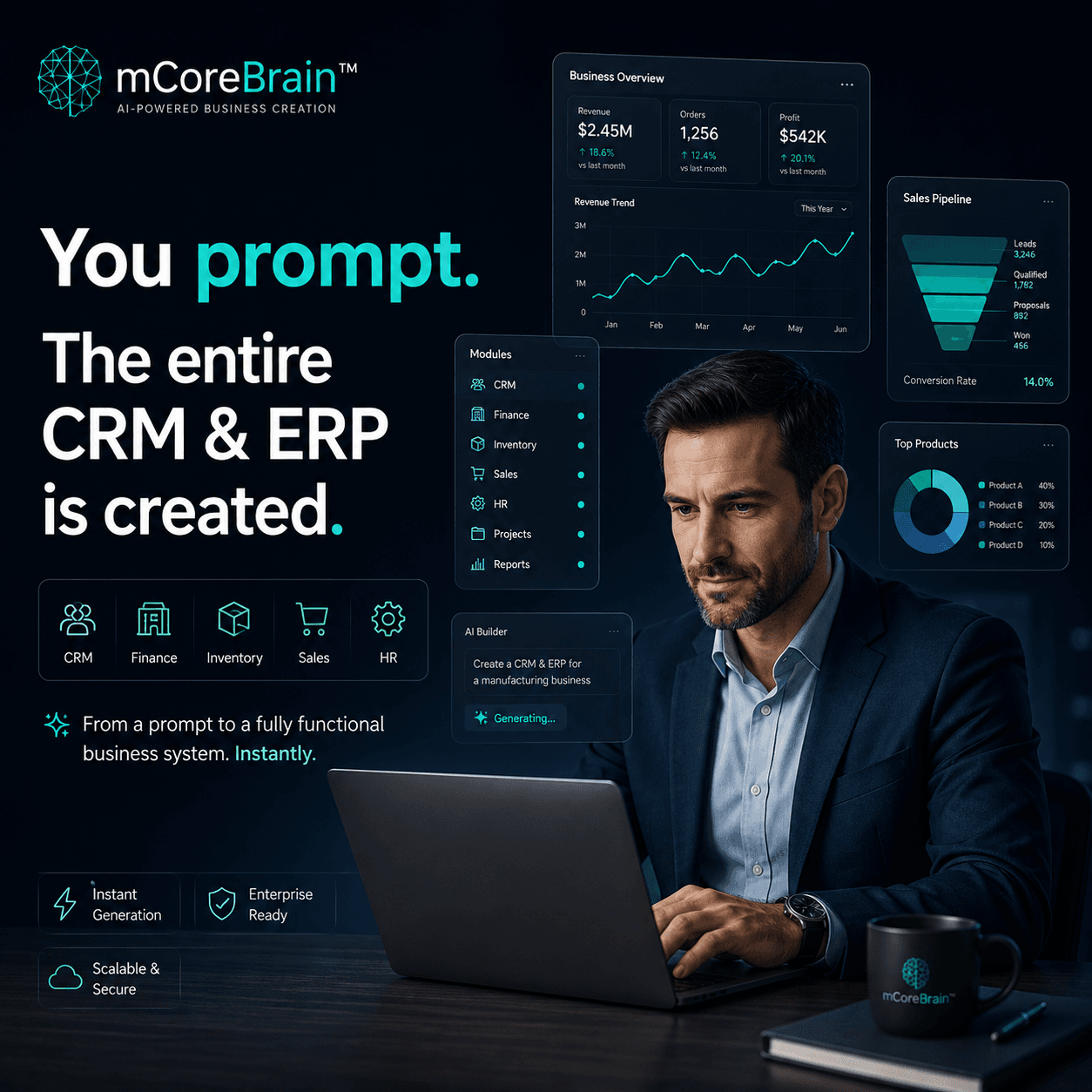
mCoreBrain is prompt-native: you describe your operation in plain language, and the AI generates your CRM/ERP in real time. For an e-commerce business, this means:
Order & Channel Unification
Describe your order flow—"capture orders from Shopify, Amazon, and our website, track fulfillment status, and sync back to each channel." mCoreBrain generates the modules, fields, workflows, and integrations instantly. No custom code. No middleware consulting. Your team logs in and starts working the same day.Real-Time Inventory Sync
Define your inventory model: multiple warehouses, reorder points, supplier lead times, and safety stock. mCoreBrain auto-generates:- Inventory counts per warehouse and SKU
- Low-stock alerts tied to purchase orders
- Reserved inventory (orders in-flight)
- Automatic channel updates to prevent overselling
- Historical tracking for demand forecasting
Fulfillment Automation
Set up workflows that move orders through your operation:- Picking and packing workflows with QC checkpoints
- Automatic label generation and carrier API integration
- Customer shipping notifications at each stage
- Return and exchange handling
- Exception routing (damaged items, address errors)
Governed Access Without Complexity
mCoreBrain's two-layer architecture separates config (what your business does) from operations (what your team executes):- Admin/Config Layer: Your ops manager designs the fulfillment workflow, inventory rules, and customer communication templates once.
- Business User Layer: Warehouse staff, customer service, and finance see only what they need—no feature bloat, no permission tangles.
Reporting That Actually Helps
Generating reports in legacy systems takes weeks (custom SQL, BI tools, IT tickets). In mCoreBrain, you ask: "Show me orders by source channel, average fulfillment time, and inventory turns by category." The dashboard appears instantly, updated live.You can slice by date, region, product, or customer segment without learning a query language.
Real Workflow: From Order to Delivery
Here's how a prompt-native system works in practice:
Day 1: Your ops lead describes the workflow:
"When an order arrives, check inventory. If stock exists, create a pick task. Once picked, create a packing task with a weight check. After packing, generate a shipping label via FedEx API, update inventory, and email the customer a tracking link. If inventory is low, alert procurement to place a PO."
mCoreBrain generates:
- Order module with channel source, status, items, and customer data
- Inventory module with warehouse location, SKU, and reserved quantities
- Pick and pack task modules with assignment and QC fields
- Shipping module linked to carrier APIs
- Procurement module for PO automation
- Notification rules for all stakeholders
No deployment engineering. No vendor onboarding calls. Just work.
Why This Matters as You Scale
Most e-commerce brands hit a wall around 7–8 figures in annual revenue. Shopify Plus works until you need custom business logic. Custom Shopify apps are fragile. Enterprise ERP is overkill and slow to change.
mCoreBrain adapts with your business. New warehouse opens? Describe it. Selling into B2B alongside B2C? Describe the difference in order flow. New supplier with different lead times? Update the rule. No roadmap tickets. No waiting for updates. Your system changes when your business does.
The Path Forward
If your e-commerce team is managing orders, inventory, and fulfillment across multiple tools and spreadsheets, you're losing time, margin, and customer trust. A prompt-native CRM/ERP closes that gap in days, not months.
Ready to unify your operations? Visit mCoreBrain.org to describe your e-commerce workflow and see your AI-native system generated in real time. No demo calls. No sales pitch. Just instant, deployable software.