How E-Commerce Brands Scale Orders Without ERP Chaos
E-commerce founders juggle inventory, orders, fulfillment, and customer data across five different tools. mCoreBrain replaces the chaos with one AI-native system.

The E-Commerce Scaling Wall
You've built a product people want. Your Shopify store is humming. Orders are coming in faster than you expected—congratulations.
Then reality hits.
Inventory numbers in Shopify don't match your warehouse counts in Google Sheets. Order fulfillment is split between Shopify, your email, and Slack messages to your team. Customer data lives in three places: Shopify, Klaviyo, and a spreadsheet you're terrified to touch. Your accountant needs monthly data that takes you two days to compile from six different sources.
You're not broken—you've just outgrown the bolt-on approach. And most e-commerce founders waste six months and $50K+ trying to glue together Shopify + Inventory tool + Fulfillment system + Analytics platform + Accounting integration.
There's a better way.
Why Traditional E-Commerce Systems Fail at Scale
The fragmentation problem is real. Shopify handles storefronts beautifully but isn't built for multi-warehouse inventory management or complex fulfillment workflows. You bolt on Cin7, ShipStation, or TrackVia—each with their own data silos, API limits, and monthly bills.
By the time you've integrated everything, you have:
- Data living in multiple places — inventory updates lag, orders get lost between systems, reconciliation takes hours
- No unified view of your business — you can't see which products are profitable across all channels, which customers are most valuable, or where fulfillment is breaking down
- High operational friction — every process requires manual workarounds; automations break when APIs drift; onboarding new team members means teaching them five different tools
- Unpredictable costs — licensing, API overage fees, integration tools, and consultant time add up fast
How mCoreBrain Fixes E-Commerce Operations
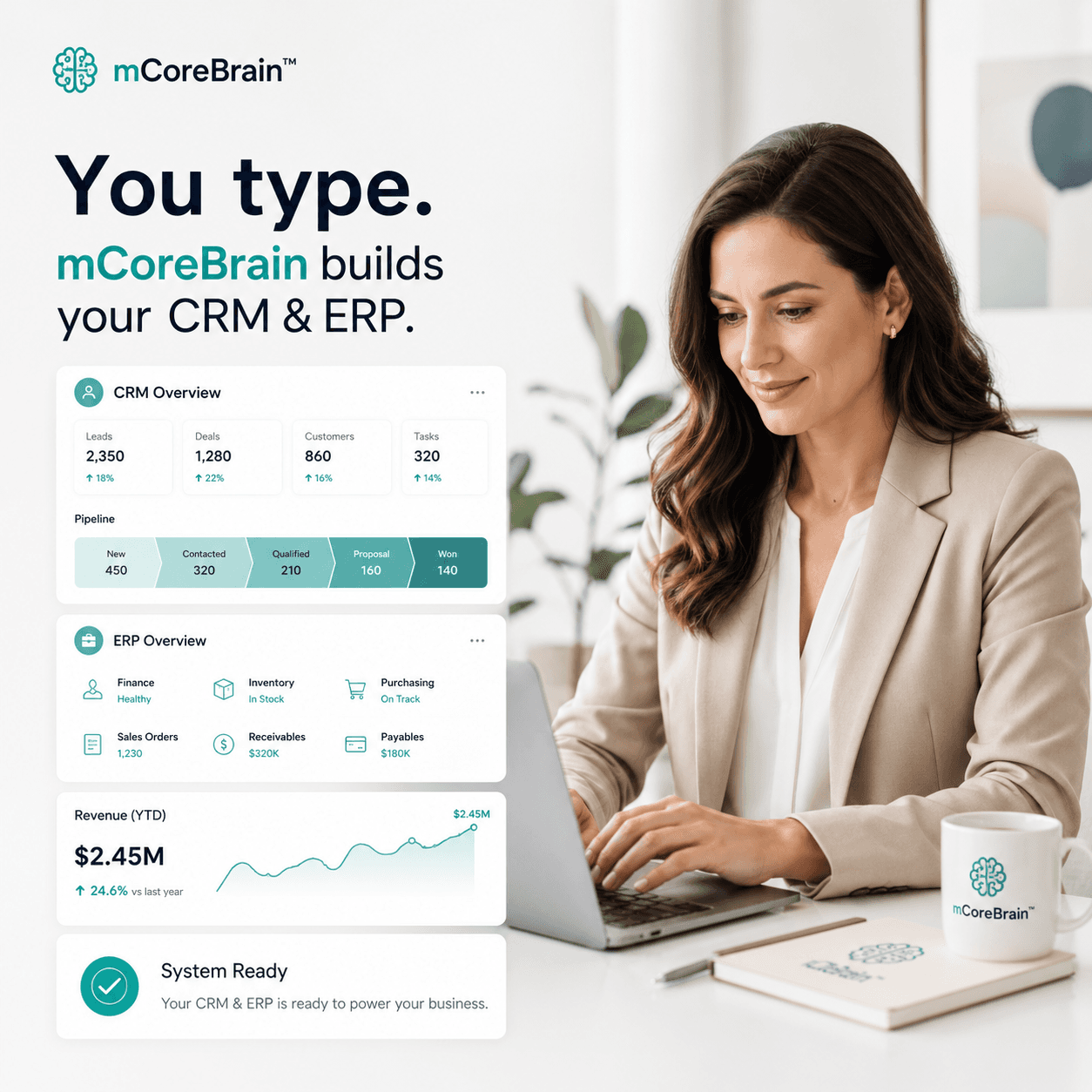
mCoreBrain is built for businesses like yours. Instead of choosing between a CRM, ERP, and fulfillment system, you describe your e-commerce operation in plain language—and mCoreBrain generates the entire system in real time.
In one prompt, you might specify:
- Multi-warehouse inventory tracking with real-time sync to your storefront
- Order intake from Shopify, Amazon, and your own site (unified pipeline)
- Fulfillment workflow with role-based tasks for warehouse, packing, and shipping teams
- Customer 360° view linking purchase history, support tickets, and lifetime value
- Financial reporting by product, channel, and margin
- Automated low-stock alerts and reorder triggers
Real Workflow: Order-to-Fulfillment
Here's how it works in practice:
- Order lands in mCoreBrain — synced directly from Shopify, your website, or manual entry. Triggered automatically or by your team.
- System checks inventory — across all warehouses in real time. If stock exists, order moves to "pick" status; if short, it routes to backorder workflow.
- Warehouse team gets task queue — mCoreBrain shows them what to pick, pack, and where to ship. No spreadsheet, no Slack confusion.
- Shipment updates flow back — tracking number auto-populated, customer notified, inventory decremented, revenue recognized.
- Finance and analytics stay current — sales by channel, by product, by customer cohort—all updated as orders flow through.
- Compliance and auditability are built in — every action logged, every workflow traceable, tax and shipping data captured automatically.
The Economics Change
When you consolidate six tools into one AI-native platform:
- Operational time drops — less manual data entry, fewer spreadsheets, faster order processing
- Errors decrease — no re-keying inventory, no order slip-ups, no reconciliation fights
- Team scales efficiently — new hires ramp up in days, not weeks; workflows are visible and auditable
- Margin improves — better inventory visibility reduces dead stock; faster fulfillment reduces customer churn
- You own your data — all your business logic and customer data lives in your system, not locked in a vendor's cloud
Deploy in Days, Not Months
Traditional ERP implementations take 6–18 months and hundreds of thousands in consulting. mCoreBrain works differently: you describe your business, deploy to production with one click, and start using it immediately. If your needs evolve—new warehouse, new sales channel, new reporting requirement—you prompt it again. The system updates in real time.
Next Steps
If you're managing e-commerce operations across multiple tools and spreadsheets, it's time to consolidate. mCoreBrain isn't another bolt-on—it's a prompt-native platform designed to replace your entire backend stack.
Learn how to build your AI-native e-commerce ERP at mcorebrain.org. Describe your business, and let AI handle the rest.