How E-Commerce Teams Scale Without Adding Headcount
E-commerce operations demand speed and flexibility, but traditional ERPs slow you down. See how prompt-native systems let small teams manage inventory, orders, and customer data at enterprise scale.
The E-Commerce Scaling Problem
E-commerce founders face a brutal choice: hire more operations staff to handle growth, or watch critical processes break under pressure. A team of three can't manually manage 500 daily orders, coordinate with suppliers, track inventory across three warehouses, and respond to customer support requests—not without burning out.
Traditional ERP systems promised to solve this. Instead, they create new problems: expensive implementation cycles, rigid workflows that don't match your actual business, and dependency on developers who cost more than your junior operators.
There's a better way. A prompt-native ERP lets a small e-commerce team automate the right processes without hiring a tech department.
What E-Commerce Operations Actually Looks Like
Let's be concrete. An e-commerce operation needs:
- Order management: Capture orders from multiple channels, route them to fulfillment, track shipping, and flag exceptions (backorders, returns, payment issues)
- Inventory sync: Real-time visibility across warehouse locations, automatic reorder points, SKU-level forecasting
- Supplier coordination: Track POs, receipt dates, quality issues, and payment terms without spreadsheets
- Customer data: Single view of customer history, purchase patterns, and support interactions
- Fulfillment workflows: Pick-pack-ship operations, label generation, carrier integration
- Financial reconciliation: Match orders to payments, track refunds, reconcile with accounting
How Prompt-Native Changes the Equation
With mCoreBrain, you describe your e-commerce operation in plain language:
"We sell on Shopify and Amazon. Orders flow to a warehouse in New Jersey and a fulfillment partner in California. We need to track inventory by warehouse, flag items below 10 units, auto-notify suppliers when we hit reorder points, and sync all customer orders into a single view for our support team."
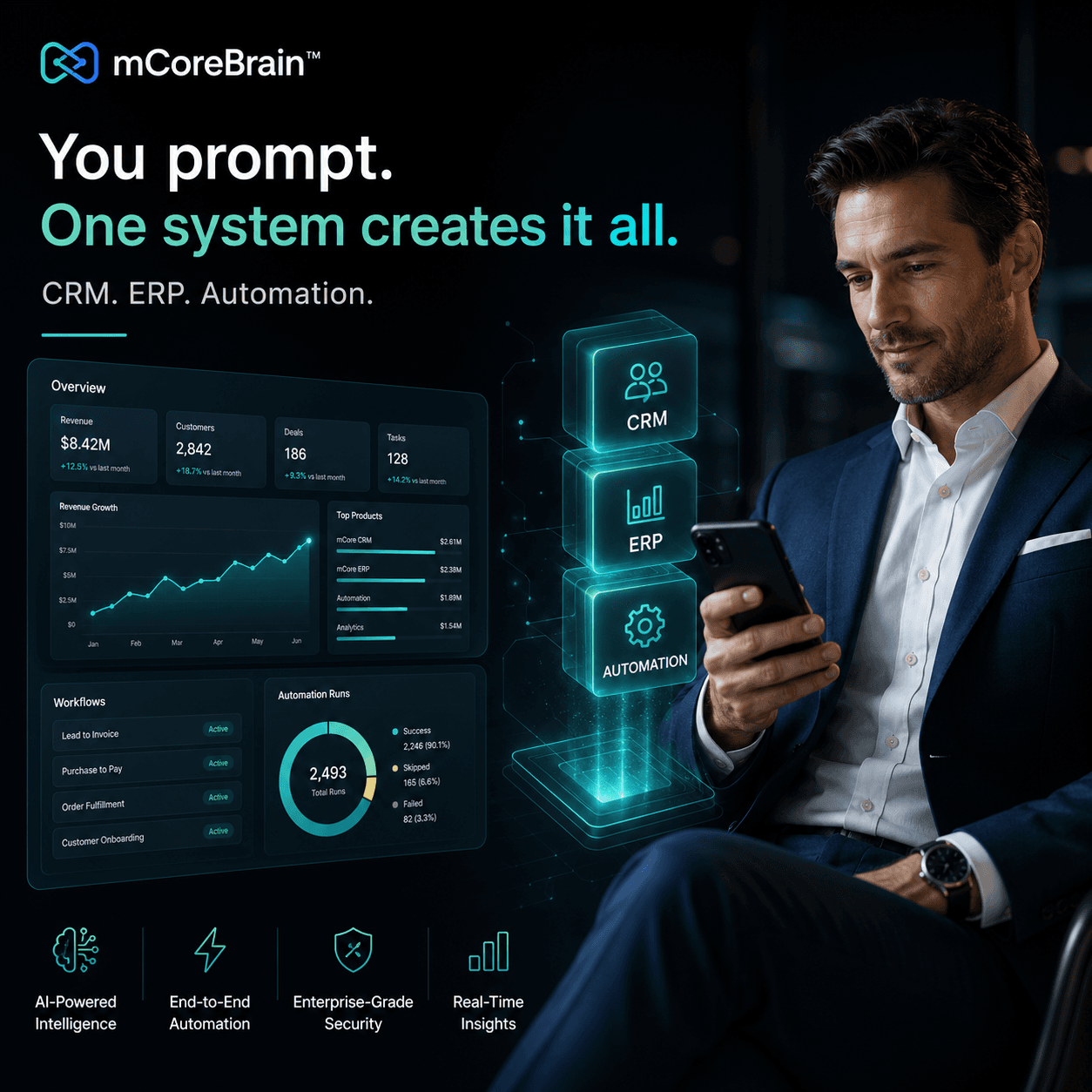
The system generates:
- Order intake modules for both channels
- Inventory tables with warehouse-level tracking and threshold logic
- Supplier portal with PO status and lead-time forecasting
- Customer 360 dashboard with order history and support interactions
- Workflows that auto-route orders based on stock location and capacity
- Role-based access (warehouse staff see picks, managers see KPIs, finance sees reconciliation)
The Real Advantage: Iteration at Business Speed
E-commerce is not static. In Q2 you launch a new product line. In Q3 you shift 20% of fulfillment to a new partner. In Q4 you run a flash sale that breaks your old inventory logic.
With a traditional ERP, each change becomes a project. With a prompt-native system, your operations manager—not a developer—owns the system. When your fulfillment logic changes, they update the prompt. When you add a new warehouse, they describe it and the system reconfigures. When you need a new report for the finance team, you ask for it in natural language.
This is transformative for small and mid-market e-commerce teams. You get enterprise-grade process management without enterprise overhead. Your team stays focused on selling and shipping, not fighting software.
Governance Matters
One concern: if anyone can change the system, won't it become chaos? mCoreBrain's two-layer governance solves this.
- Admin/config layer: Only ops leaders can define core processes, data structure, and roles
- Business user layer: Staff interact with the system mCoreBrain generated, not the underlying rules
The Numbers That Matter
For a typical e-commerce team:
- Time to deploy: Days instead of months
- Cost: Licensing, not implementation consulting
- Admin overhead: One person can manage a system that would require two in traditional software
- Iteration speed: Process changes in hours, not weeks
Next Steps
If you're scaling e-commerce operations and tired of spreadsheets and Frankenstein integrations, it's time to evaluate a system built for how modern commerce actually works.
Visit mCoreBrain.org to see how a prompt-native ERP can let your small team operate at enterprise scale—without the enterprise complexity.