How Hospitals Manage Patient Flow, Staff & Revenue Without Legacy Chaos
Hospital operations span patient intake, clinical workflows, staff scheduling, billing, and compliance—all critical, all fragmented. mCoreBrain unifies them in one AI-native system.

The Hospital Operations Nightmare
Hospitals run on complexity. A single patient admission triggers a cascade of dependencies: registration systems, EHR platforms, nursing schedules, pharmacy orders, lab requests, billing workflows, and compliance checkpoints. Each system operates in isolation. Data doesn't flow cleanly between them. Staff waste hours pulling information from multiple screens. Billing claims get delayed or rejected because discharge summaries haven't synced. Emergency departments bottle up because bed availability isn't visible to triage. Revenue leaks through billing errors and missed charges.
Traditional ERP and billing systems promise integration—but they require consultants, custom code, months of implementation, and inflexible workflows that force hospitals to adapt to the software instead of the other way around.
Why mCoreBrain Changes the Game for Healthcare
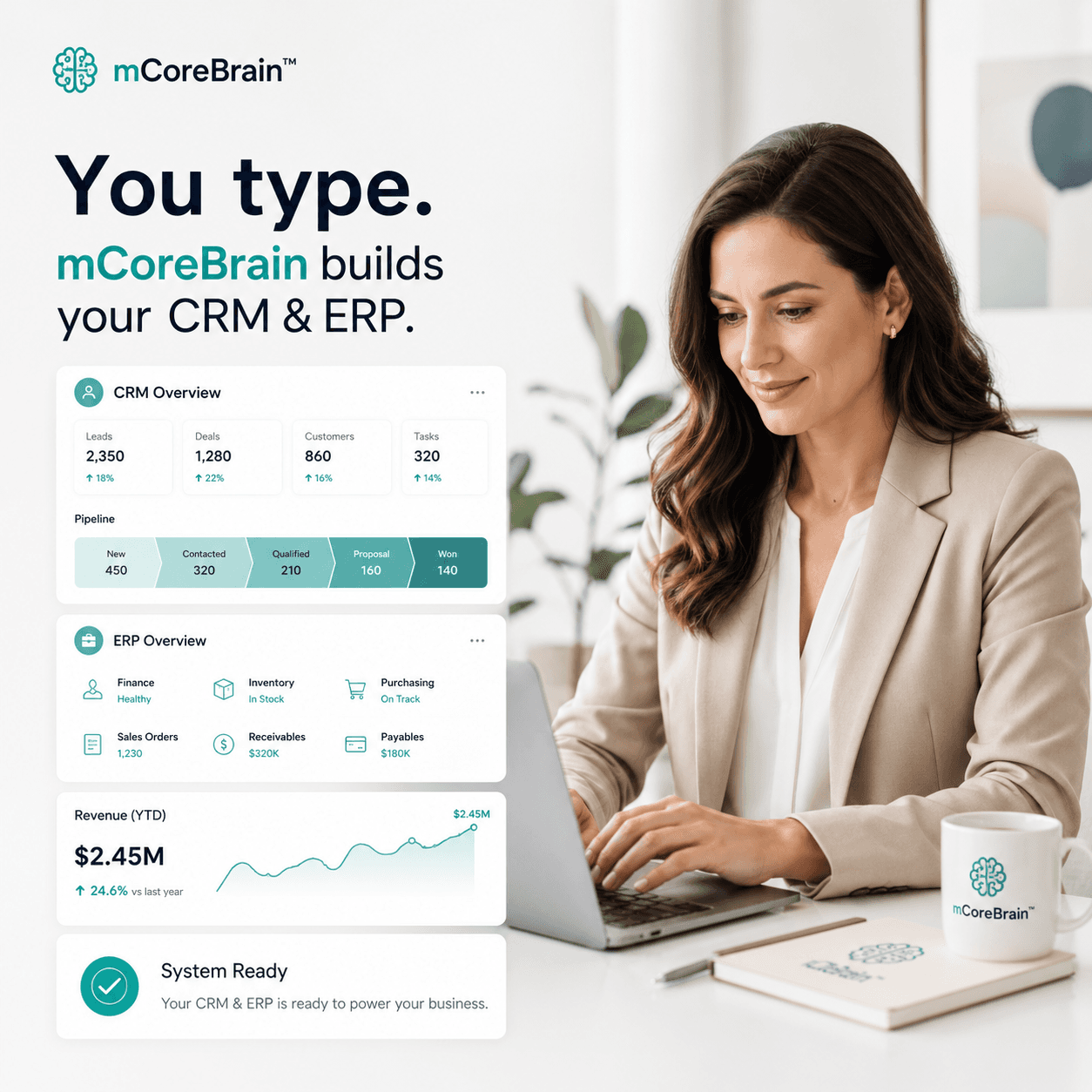
mCoreBrain is prompt-native. Instead of configuring fields and workflows through a UI, hospital administrators describe their operations in plain language:
"We need to track patient admissions, assign nursing staff by specialty and availability, generate daily bed reports, and auto-trigger billing workflows when discharge notes are complete."
The AI generates the full system—modules, fields, pipelines, role-based access, automations—instantly. No consultants. No code. No six-month rollout.
What Hospitals Actually Need
Patient Lifecycle Management: From intake to discharge, every patient record needs to flow through admission → triage → clinical care → billing → discharge. mCoreBrain lets you define custom pipelines for each patient type (surgery, emergency, critical care, outpatient). Staff see real-time patient status. Doctors, nurses, and billing teams all pull from one source of truth.
Staff Scheduling & Capacity: Hospitals need to match staff expertise (ICU nurses, cardiologists, anesthesiologists) to patient demand, shift constraints, and certifications. mCoreBrain can track staff roles, certifications, availability, and auto-assign shifts based on patient census and specialty. Changes ripple instantly—no more phone tag between nursing and scheduling.
Bed Management: One of the most common bottlenecks. Which beds are occupied? Which are cleaning? Which are reserved for incoming emergency cases? mCoreBrain unifies bed status, discharges, transfers, and admissions into a live dashboard. ER wait times drop because bed availability is instant and transparent.
Billing & Revenue Cycle: Charges get captured at the point of care (lab orders, medications, procedures), linked to the patient record, and auto-batched for claim submission. Denials and delays shrink because documentation is complete and attached to each charge. Revenue cycle teams see bottlenecks before they become backlogs.
Compliance & Documentation: HIPAA, CMS reporting, accreditation audits. mCoreBrain's two-layer architecture (admin/config layer + business user layer) means compliance rules are locked at the config level—clinicians cannot accidentally override them. Audit trails are automatic. Reports for regulators are pre-built.
How It Works in Practice
A patient arrives at the ED. Triage nurse inputs: age, presenting complaint, vital signs. mCoreBrain's AI sees the complaint, recommends an intake workflow (e.g., chest pain → EKG + cardiology consult). The system auto-assigns available beds by acuity, alerts the nursing station, and pre-populates the clinical workflow. Blood work is ordered. Lab gets notified. When results come back, they auto-attach to the patient record and alert the ordering physician. Diagnosis is documented. Treatment plan is set. Once the patient is discharged, billing auto-triggers, charges are submitted, and the bed flips back to "available."
The entire flow is transparent. No lost orders. No forgotten charges. No data entry in three systems.
The Real Competitive Edge
Hospitals that move faster reduce patient wait times, improve staff morale (less manual data entry), and recover revenue that gets lost in system gaps. In an industry where reimbursement is shrinking and patient volumes are unpredictable, operational efficiency is survival.
mCoreBrain doesn't require IT teams to write integrations or modify code every time a workflow changes. When a hospital acquires a new service line or adjusts staffing models, the AI simply regenerates the system. Configuration changes happen in days, not quarters.
Governance & Security
Healthcare operations are high-risk. mCoreBrain's governed architecture means compliance rules, access controls, and audit requirements are baked in at the config layer. Clinicians cannot see what they shouldn't. Billing staff cannot alter clinical records. Administrators have full visibility into every workflow change. Deployment is one click—to a HIPAA-compliant infrastructure.
Start Here
If your hospital is juggling multiple systems, burning staff hours on data entry, or losing revenue to billing delays, the path to modern operations starts with a single prompt. Describe how your hospital works. Let mCoreBrain build the system that actually fits your operations.
Learn how prompt-native CRM/ERP can transform healthcare operations. Visit mCoreBrain.org to see a live demo and get started in minutes—no implementation project required.