How Legal Teams Manage Cases & Billing Without Legacy Software
Law firms waste hours toggling between case management, billing, and document systems. mCoreBrain lets legal teams build their exact workflow in plain English.

The Legal Tech Trap
Most law firms operate across 3–5 disconnected tools: a case management system, a billing platform, a document repository, and email. Partners and associates spend their day context-switching, re-entering data, and chasing down case status updates. Paralegals manage spreadsheets of open matters. Billing cycles slip. Client communication lags.
Worse: traditional legal software is expensive, inflexible, and built for firms that don't match your practice model. A boutique IP firm needs different workflows than a 500-person corporate practice. A solo practitioner shouldn't pay for features designed for litigation management. Yet most legal tech vendors lock you into their predefined schema.
What Legal Teams Actually Need
At its core, a law firm is a matter-driven business. Every action—time entry, document, communication, billing event, deadline—ties back to a client matter. The system should reflect that.
You need:
- Unified matter tracking: case status, parties involved, dates, outcomes — all visible at a glance
- Time & billing integration: associate hours logged directly to matters; invoices generated without re-keying
- Task & deadline management: court dates, statute of limitations, discovery deadlines synced across the team
- Document control: versions, custodians, privilege notes tied to the matter
- Client portal access: clients see case progress and bills; you reduce email noise
- Role-based access: partners see P&L, associates see only their matters, admins manage firm-wide settings
How mCoreBrain Works for Law Firms
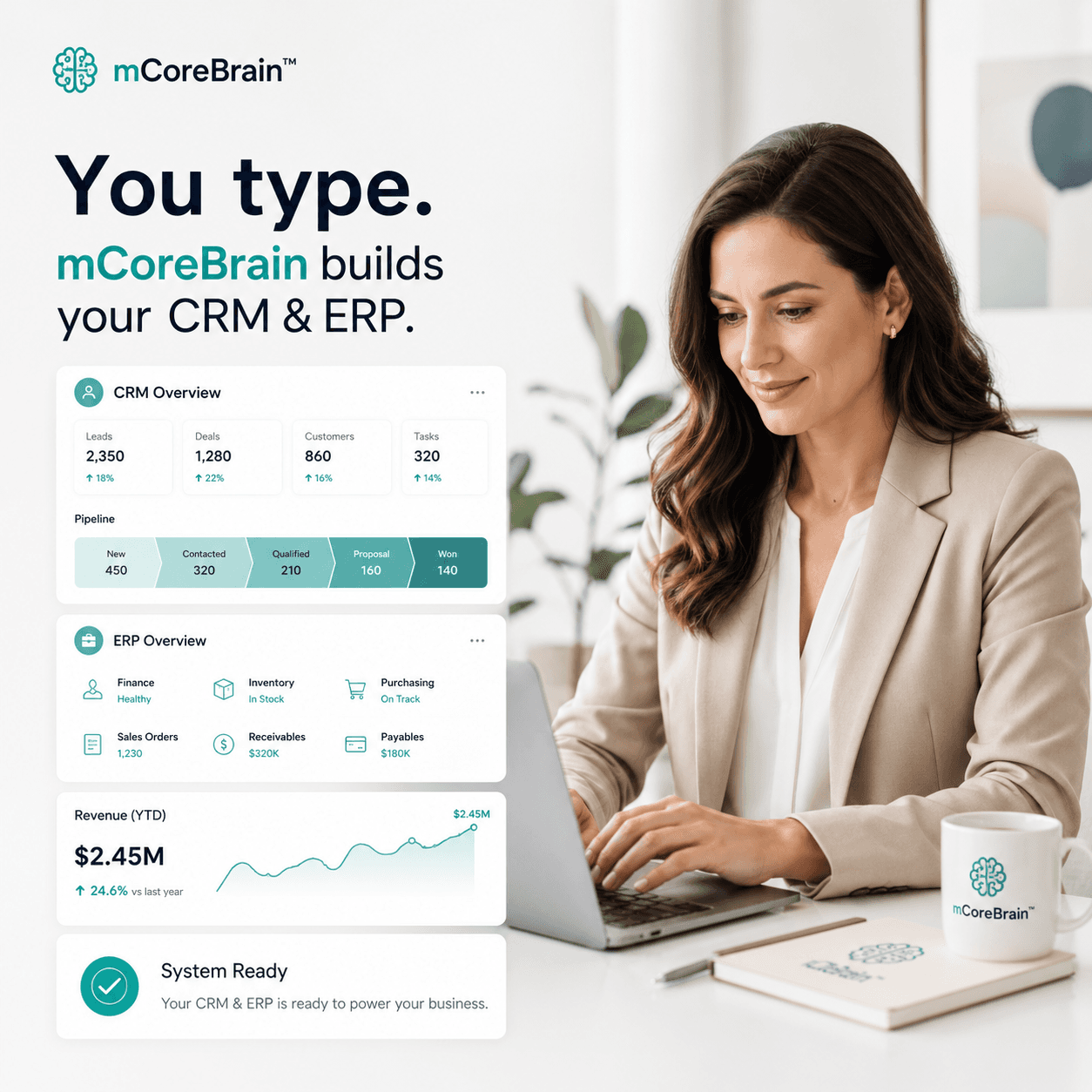
Instead of forcing your firm into a pre-built box, mCoreBrain lets you describe your practice in plain English—and instantly generates your CRM/ERP.
Here's the workflow:
1. Define your model (in a chat, in plain language):
- "We manage client matters with names, case types, and assigned attorneys."
- "Each matter has associated tasks with deadlines."
- "Associates log billable hours to matters; I need invoices auto-generated monthly."
- "Partners need a dashboard showing revenue by practice area."
- "Clients should see matter status and invoices via a portal."
- Matter record type with fields for case name, client, attorney, status, matter type
- Task module with deadline tracking and owner assignment
- Time entry form linked to matters
- Billing pipeline that auto-generates invoices
- Role-based dashboards for partners, associates, and admins
- Client portal with read-only matter & invoice access
4. Your team starts using it immediately—then you refine. Need a "next court date" field? Add it in the admin layer. Want to track expert witnesses? New record type, generated in seconds. Need a new workflow? Describe it, mCoreBrain builds it.
Real-World Impact
Time savings: Paralegals no longer chase down matter status via email. Associates log time once; it flows to billing automatically. Invoices are generated, not manually assembled.
Accuracy: No more double-entry errors. One source of truth for each matter, task, and time entry.
Flexibility: You're not locked into someone else's case template. Your matter model evolves as your practice grows.
Cost: No licensing per-user, no vendor lock-in, no 18-month implementation. Deploy this week.
Compliance: Role-based access ensures confidential matters stay private. Audit trails track who accessed what. mCoreBrain's two-layer governance (admin config + business user layer) separates sensitive configuration from day-to-day operations.
Why This Matters Now
Legal tech has been stuck for a decade. Firms either buy enterprise software (expensive, slow to customize) or jury-rig Airtable and Zapier. Neither scales gracefully.
AI-native CRM/ERP changes the equation. Instead of adapting your practice to software, you describe your practice and the software adapts to you. That's what prompt-native means: your requirements drive the system architecture, not the reverse.
For legal teams tired of workarounds, mCoreBrain offers a faster, simpler path to a system that actually matches how you work.
Next Steps
Ready to build the case management system your firm deserves—without months of implementation and six-figure licenses? Visit mcorebrain.org to see how you can design your legal CRM in minutes and deploy it today. Describe your practice, let AI do the heavy lifting, and focus on what matters: serving your clients.