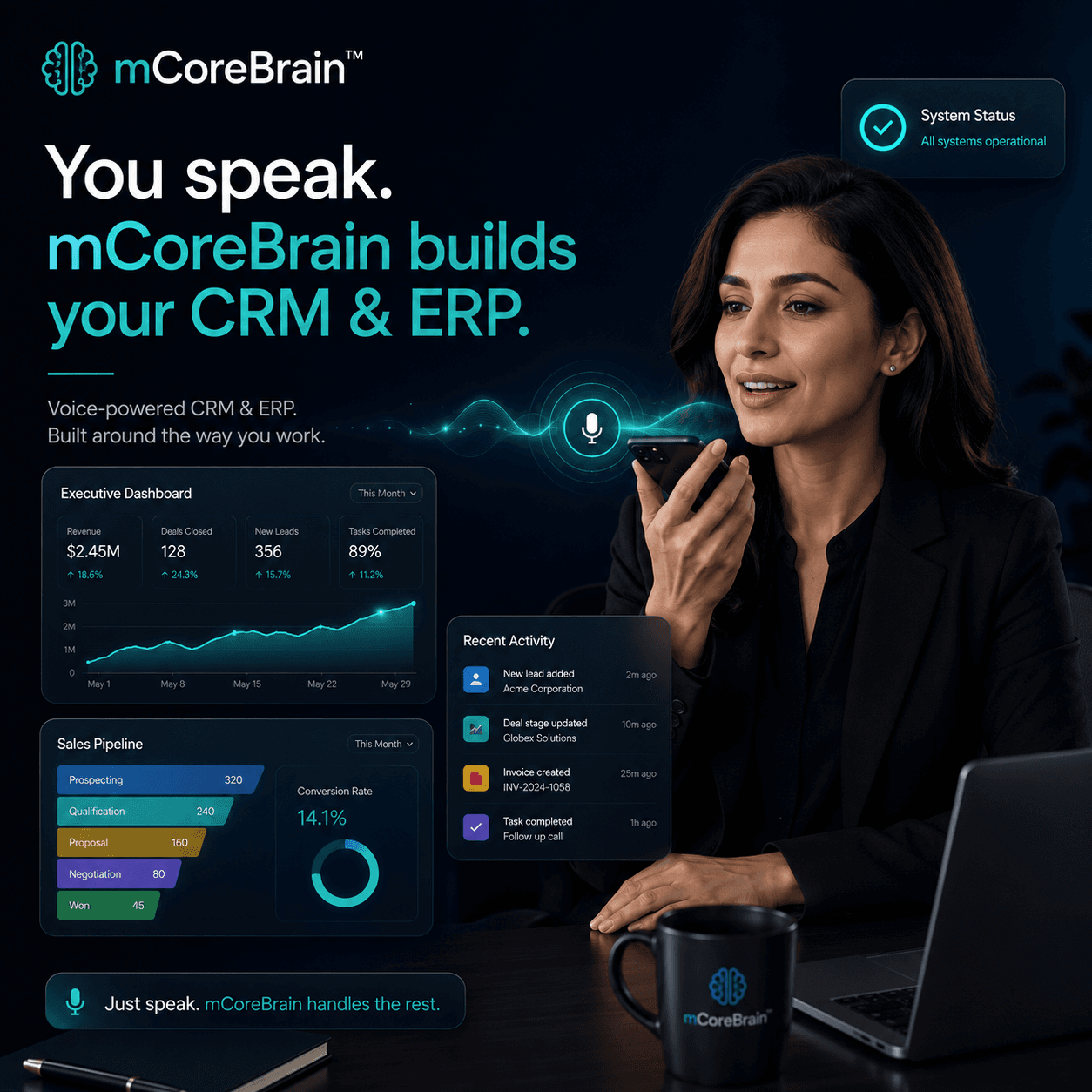
How Logistics Firms Track Shipments, Teams & Margins
Logistics companies juggle routes, drivers, customers, and costs across dozens of systems. mCoreBrain replaces the chaos with one AI-native platform.

The Logistics Nightmare: Systems Everywhere, Visibility Nowhere
A mid-sized logistics firm operates across three cities, manages 50+ vehicles, coordinates with 200+ customers, and processes 5,000+ shipments monthly. Here's what their tech stack looks like:
- TMS (Transportation Management System) for routes and tracking
- Separate accounting software for invoicing and margins
- Email and spreadsheets for customer communication
- Manual driver logs on paper or basic apps
- Disconnected warehouse management for pickups and deliveries
- Slack and phone calls for coordination
This is the problem mCoreBrain solves.
What a Prompt-Native CRM/ERP Means for Logistics
With mCoreBrain, a logistics manager describes their operation in plain English:
"I need to track shipments from pickup to delivery. Each shipment has a customer, driver, vehicle, route, and revenue. Drivers need to see their daily manifest. Finance needs to invoice when delivery is confirmed. Operations needs alerts when shipments are delayed. I need dashboards showing vehicle utilization, on-time rate, and revenue per driver."
mCoreBrain generates the entire system in minutes:
- A shipment module with customer, driver, vehicle, pickup/delivery locations, status, and weight
- Driver portal showing assigned shipments, real-time navigation, and proof-of-delivery capture
- Customer self-service to track their shipments live
- Automated invoicing triggered by delivery confirmation
- Role-based dashboards: operations sees delays and exceptions, finance sees revenue and costs, drivers see their daily queue
- Alerts and workflows: route optimization suggestions, late-delivery notifications, revenue reconciliation
- Integration ready: connect to GPS tracking, accounting software, or customer notification systems
Why This Matters for Logistics ROI
1. Visibility Cuts Waste
When every shipment is live in one system, operations can spot bottlenecks instantly. A delivery stuck in customs? The system flags it. A driver's route is inefficient? The dashboard shows it. Customers don't call asking "where is my package?" — they check the portal themselves.2. Revenue Doesn't Disappear
Late or forgotten invoices are endemic in logistics. When delivery status automatically triggers invoicing, revenue is captured the moment it's earned. No more chasing missing invoices or margin leaks.3. Driver Retention Improves
Drivers hate unreliable systems. A clean, mobile-friendly portal that shows their daily manifests, gives them real-time customer feedback, and confirms proof-of-delivery feels professional. They're equipped to do their job well.4. Customers Get Loyalty
When customers can track their shipment live and get accurate delivery windows, complaint rates drop. Repeat business improves. You stop being a commodity.5. Finance Gains Control
Accounting teams can reconcile revenue instantly. They see which customers pay late, which routes are profitable, which vehicles are underutilized. Margins stop being a mystery.The Practical Workflow
Here's how a day works with mCoreBrain:
- Morning: Dispatcher describes today's pickups and deliveries → system generates optimized routes → drivers receive manifests on their phones
- Throughout day: Drivers scan barcodes and capture signatures → system updates shipment status in real time → customers see live tracking
- At delivery: Proof-of-delivery is captured → system automatically generates invoice → finance sees revenue immediately
- End of day: Operations review on-time metrics and exception reports → finance reconciles cash → next day's forecast is ready
Why Traditional Systems Fail Logistics
A typical TMS is built for transportation only. It doesn't talk to accounting. Your accounting software doesn't know about deliveries. Your CRM doesn't know your routes. You end up managing the gaps between systems, not managing the business.
mCoreBrain inverts this: you describe your business, the AI builds the system to match. If you need to track profitability by customer segment and by vehicle type and by geographic region, you just say so. The system generates it instantly.
What's Next?
If your logistics firm is drowning in system sprawl, email chaos, and margin leaks — or if you're growing and can't afford a year-long ERP implementation — it's time to try a new approach.
Head to https://mcorebrain.org and describe your operation in plain language. See your AI-native CRM/ERP built in minutes. Deploy to production with one click. Finally, manage logistics instead of managing systems.