How Logistics Operators Manage Shipments & Revenue Without System Sprawl
Logistics operators juggle shipments, carriers, customers, and invoices across disconnected tools. mCoreBrain unifies everything—tracking, billing, compliance—in one prompt-native system.
The Logistics Operator's System Problem
A mid-sized logistics coordinator manages 200+ shipments per week across 15 carriers, dozens of customers, and multiple warehouses. Today, her workflow looks like this:
- Shipment tracking: TMS (transportation management system)
- Customer orders & communication: Email + spreadsheets + Slack
- Carrier management & rate negotiations: Separate vendor portal + Excel
- Invoicing & revenue recognition: QuickBooks + manual reconciliation
- Compliance & documentation: Shared drive + PDF chaos
- Team coordination: Monday.com for project updates
Traditional CRM/ERP tools don't fit. Salesforce is built for sales pipelines, not shipment tracking. SAP requires 18 months and a consultant team. Monday.com is a project board, not a business system. She needs a system designed for logistics operators—built in minutes, not months.
Why Prompt-Native Wins for Logistics
mCoreBrain changes the equation. Instead of buying a pre-built "logistics solution" and forcing your workflows into it, you describe your business in plain language and AI generates the entire system.
Your logistics workflow:
- "Track each shipment with origin, destination, carrier, status, and customer."
- "Link shipments to customers and automatically generate invoices based on weight, distance, and service level."
- "Track carrier performance: on-time rate, cost per mile, damage claims."
- "Flag compliance issues: hazmat documentation, required signatures, customs paperwork."
- "Show revenue by customer, by lane, by carrier."
- Shipment records with built-in workflows (pending → in transit → delivered → invoiced)
- Customer dashboards showing order history, costs, and KPIs
- Carrier scorecards and rate management
- Automated invoice generation tied to shipment completion
- Compliance checklists and document storage
- Role-based access (drivers see assigned loads; ops managers see all metrics; finance sees billing)
- Mobile views for field teams
Real Workflow: A Day in the System
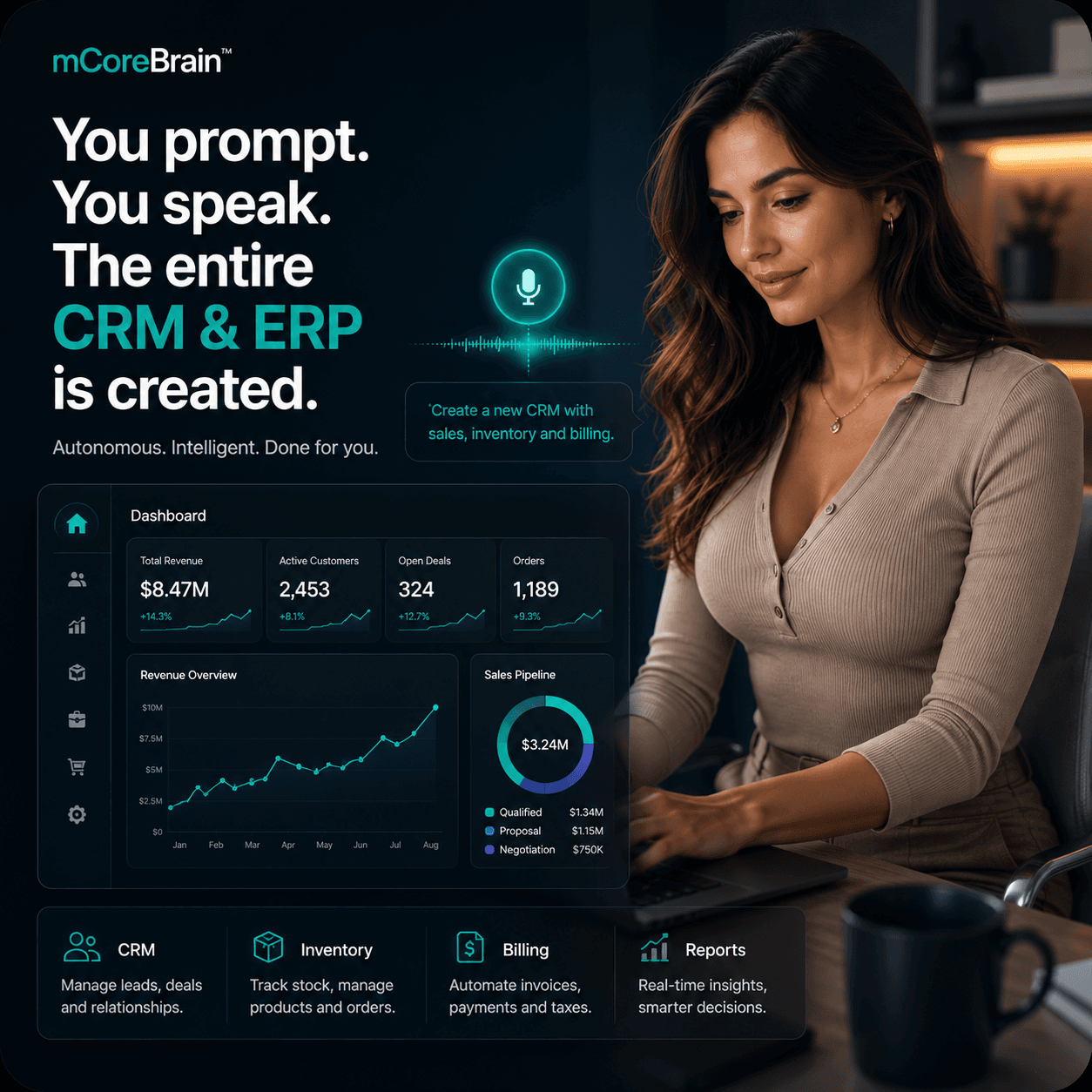
Morning: Operations manager logs in. Dashboard shows:
- 18 shipments in transit (status, ETA, carrier performance trending)
- 3 shipments delayed (reason, customer impact, recovery actions)
- Yesterday's revenue: $12,400 across 47 deliveries
- Carrier performance: ABC Trucking on-time rate 94% (yellow alert: below 96% threshold)
Afternoon: Shipment delivered. System automatically:
- Updates tracking status
- Calculates invoice amount based on shipment data
- Sends proof-of-delivery to customer
- Records revenue and updates carrier metrics
- Flags if customer account needs attention (credit limit, payment status)
- Revenue by customer (which ones justify dedicated lanes?)
- Cost by carrier (which partnerships are profitable?)
- Cash flow forecast (when invoices get paid)
- Compliance status (all required docs attached?)
Why This Matters
Logistics is margin-sensitive and complexity-heavy. A 2% efficiency gain is real profit. Traditional ERP trades flexibility for bloat—you get 300 features you don't need and can't customize the 5 you do. mCoreBrain trades bloat for speed: you get exactly the system your logistics operation needs, configurable in hours, not years.
The business impact:
- Faster decision-making: Real-time visibility into profitability, bottlenecks, and performance
- Lower costs: Right-sized tool (no enterprise ERP license fees); fewer manual touchpoints
- Better customer service: Accurate tracking, predictable billing, faster issue resolution
- Scalability: Add new lanes, carriers, or warehouses by describing them to AI—system adapts instantly
- Compliance confidence: Built-in checklists and documentation tracking reduce audit risk
The Next Step
If you manage shipments, carriers, customers, and billing—and you're tired of tool sprawl—it's time to see what a prompt-native system can do. mCoreBrain isn't designed for logistics by committee. It's designed to work the way you actually do logistics.
Visit mCorebrain.org to describe your logistics workflow and generate a production-ready system in minutes. No consultants. No long implementation. Just AI that understands your business.