How Logistics Operators Track Shipments & Cut Overhead 40%
Traditional logistics software is rigid and slow to adapt. mCoreBrain lets operators describe their workflow once—then AI generates a custom system that tracks shipments, manages routes, and scales without hiring developers.
The Logistics Bottleneck: Rigid Software Meets Real-World Chaos
Logistics operators live in a world of constant change. A shipment gets delayed, a driver calls in sick, a customer demands a faster route, or a new carrier comes online. Your existing ERP or dispatch system can't adapt fast enough—every tweak requires a developer, a ticket, a week-long sprint, and $10K in consulting fees.
Meanwhile, your team is juggling spreadsheets, manual status updates, phone calls with drivers, and customer escalations. You're losing visibility. Shipments slip through the cracks. Drivers are under-optimized. You're hemorrhaging margin on every route.
The core problem isn't technology—it's inflexibility. Traditional logistics software treats your business as a bolt-on to their template. mCoreBrain flips that script entirely.
How Prompt-Native Works for Logistics
Instead of forcing your operations into a pre-built box, you tell mCoreBrain what you actually do:
**"We manage regional LTL shipments with 40 drivers across three hubs. Every shipment has a pickup location, dropoff, weight, hazmat classification, and customer SLA. Drivers submit status updates via mobile. We need real-time route optimization, automated alerts when shipments miss their window, and a dashboard that shows hub managers what's pending vs. completed."
That's it. No RFP. No vendor demos. No 6-month implementation.
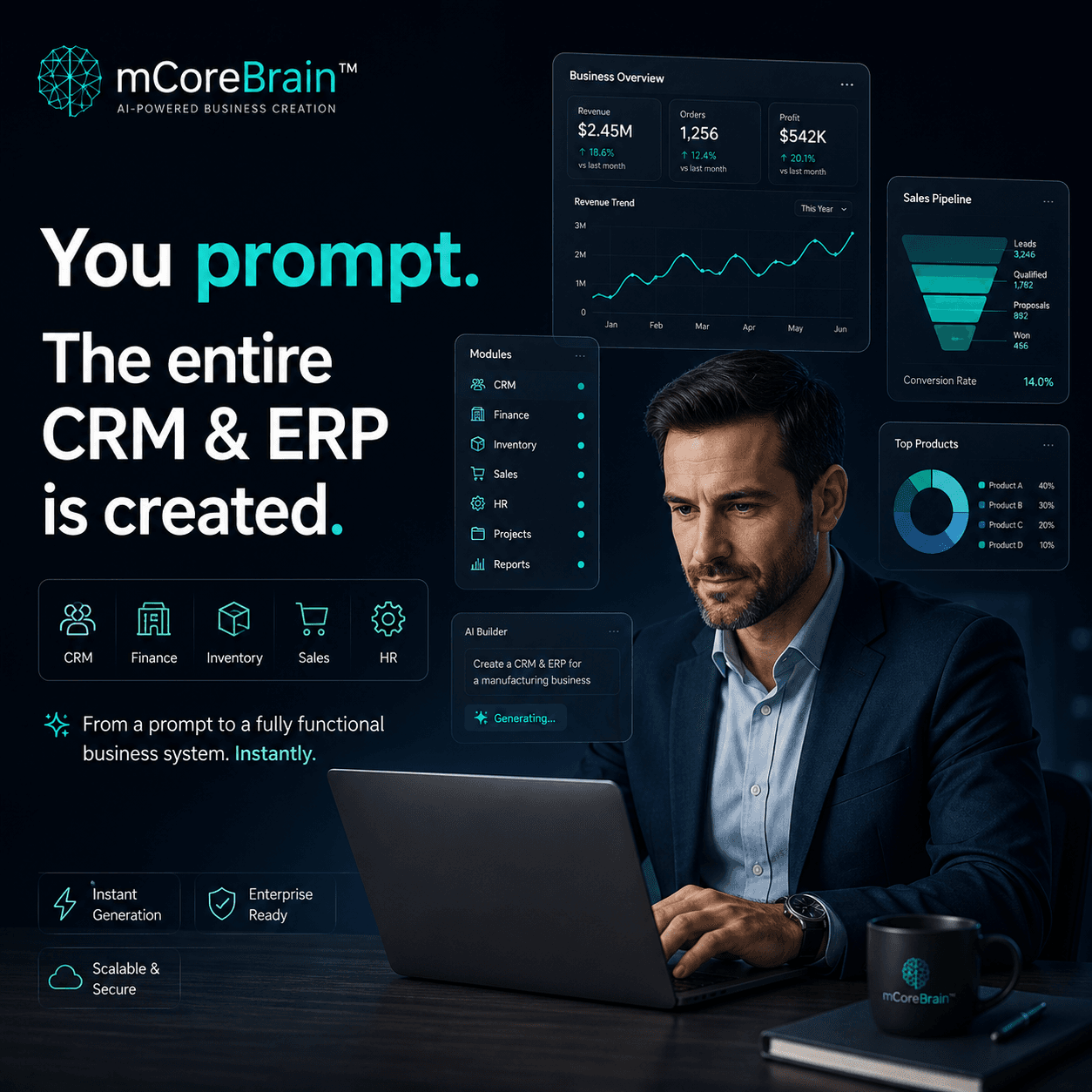
mCoreBrain generates your entire system:
- Data model: Shipments, drivers, routes, customers, hubs, SLA rules
- Workflows: Auto-assign shipments to drivers based on capacity, location, hazmat certification
- Mobile interface: Driver app for status updates, proof of delivery, exception reporting
- Dashboards: Real-time visibility by hub, driver, customer, SLA compliance
- Alerts: SMS/email when a shipment is at risk, when a driver is idle, when a route is inefficient
- Role-based access: Hub managers see their region only; dispatch sees everything; drivers see their assigned loads
- Integrations: Pull customer orders from your e-commerce system, sync addresses to Google Maps API for routing
Why This Matters for Your Bottom Line
Reduced overhead: No IT consultants. No custom development. No ongoing licensing bloat for modules you don't use. Your system grows with your business, not your software bill.
Faster adaptation: Customer demands a new SLA type? Add it to the prompt. Acquired a smaller competitor and need to merge fleets? Regenerate your system to include their drivers and hubs. Business changes no longer get stuck in the software-release queue.
Better driver retention: Drivers spend less time waiting for dispatch clarification or checking spreadsheets. The mobile app is intuitive and purpose-built for them—not generic.
Smarter route planning: Instead of static rules, you can layer in real-time constraints: traffic, weather, driver fatigue, vehicle maintenance windows, customer time windows. The system learns what works and recommends optimizations.
Compliance and audit trails: Every shipment movement, driver action, and SLA miss is logged. No more finger-pointing. No more "I thought he handled that."
The Governance Layer Keeps You Safe
Logistics is high-risk: liability, safety, compliance. mCoreBrain's two-layer architecture protects you:
- Admin/config layer (your leadership team): Set business rules—SLA definitions, driver certifications, hazmat rules, rate structures, alert thresholds
- Business user layer (dispatch, drivers, customers): Operate within those guardrails. No one can create a shipment without a valid customer. No driver can be assigned a load they're not certified for. No invoice goes out until delivery is proven.
Real-World Example Flow
- Customer books a shipment via your web portal (or API)
- System auto-validates: hazmat classification, carrier SLA, pickup/dropoff coverage, available capacity
- AI-generated workflow assigns the shipment to the optimal driver/truck based on location, load, and certification
- Driver receives notification on mobile app; accepts or requests modification
- Real-time tracking pings customer and your dashboard
- Proof of delivery captured via photo/signature; triggers invoice generation
- Exception? System alerts dispatch immediately; suggests reroute or escalates to customer service
- EOD report auto-generates SLA compliance by hub, driver, customer
Next Steps
If your logistics team is drowning in coordination overhead, rigid software is the anchor. mCoreBrain replaces the old waterfall approach with prompt-native flexibility—you describe your operations once, and the system adapts with you.
Visit mCoreBrain.org to see how other operators are reclaiming 40+ hours per week and cutting logistics overhead. Describe your workflow in plain language. Watch your CRM/ERP generate in real time. Deploy to production with one click.