How Manufacturing Firms Manage Production Without ERP Sprawl
Manufacturing leaders struggle with fragmented systems for orders, inventory, and production schedules. mCoreBrain eliminates the sprawl with one AI-native platform.
Manufacturing is broken into silos. Your sales team uses one system, production planning lives in another, inventory tracking is a spreadsheet, and quality control is scattered across email and spreadsheets. When a rush order arrives, nobody has a single source of truth.
Traditional ERP systems promised to solve this. SAP, Oracle, NetSuite—they cost millions, take years to implement, require armies of consultants, and still leave you with rigid, slow-moving bureaucracy. By the time you customize them for your actual process, you've blown the budget and your team is training on software that fights how you actually work.
The Real Problem: Fragmentation Kills Efficiency
Most manufacturers rely on a patchwork:
- Order management lives in Salesforce or a legacy system
- Production schedules are managed in Excel or outdated MRP software
- Inventory levels are tracked manually or in disconnected spreadsheets
- Quality checks are logged on paper or in isolated databases
- Supplier communication happens via email, text, or disconnected procurement tools
- Real-time visibility doesn't exist—you discover problems after they've cost you money
The result: missed deadlines, excess inventory, expedited shipping costs, scrapped products, and angry customers.
Why mCoreBrain Changes the Game
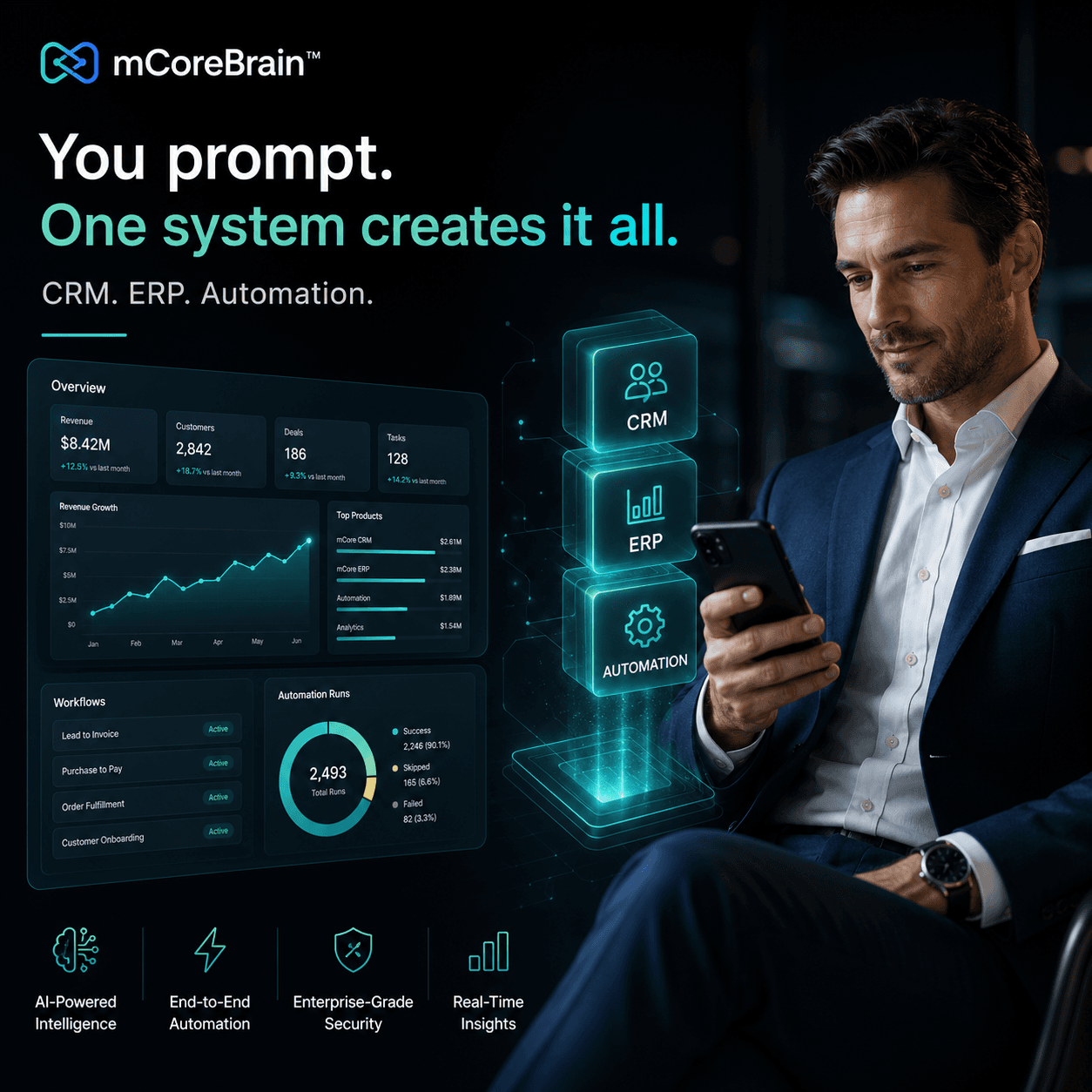
mCoreBrain is built for this exact problem. Instead of forcing your team into rigid software logic, you describe your manufacturing process in plain language, and AI generates the entire system—fields, workflows, dashboards, and role-based access—in minutes.
Here's what this actually looks like:
Your operations director describes the flow: "We take customer orders, check inventory and lead times, create production schedules based on available capacity, assign work to stations, track quality at each step, and notify the customer when it ships."
mCoreBrain generates:
- An order intake form with automatic inventory validation
- A production scheduling module that shows capacity constraints in real time
- A shop floor dashboard that assigns work orders to stations and tracks progress
- A quality inspection checklist tied to each production step
- Automatic inventory deductions when production starts
- Customer notifications triggered at key milestones
- Supplier visibility into upcoming demand
- Executive dashboards showing on-time delivery rate, inventory turnover, and production efficiency
Real-World Impact
Visibility across the operation. Every team—sales, production, procurement, quality, shipping—sees the same data in real time. A sales manager knows if an order can ship on time before promising it to the customer. A production planner sees demand 30 days out. A procurement manager sees when to order raw materials based on what's actually scheduled.
Faster decision-making. When a machine breaks down, the production schedule updates automatically. When a supplier delays a shipment, procurement can flag at-risk orders immediately. When a customer calls with a rush request, you can answer "yes" or "no" in minutes, not days.
Lower costs. You reduce excess inventory because you're not building a buffer for blind spots. You avoid expedited shipping because you can actually plan. You catch quality issues earlier, not after the product ships. Your team spends time on high-value work, not data entry and reconciliation.
Scalability without bloat. As you grow or add product lines, you adjust your system by describing the new process. mCoreBrain regenerates the relevant modules. No software architecture degree required.
The Governance Layer Matters
One concern: if an AI system can change fields and workflows, how do you prevent chaos? mCoreBrain uses a two-layer architecture. Admin and power users can modify the system's structure and logic on the config layer. Business users operate on the business layer—they enter data, run reports, and execute workflows, but can't accidentally break the system. Security and compliance controls are governed by design.
From Description to Production in Hours
The real difference is speed and ownership. You're not hiring a consulting firm to translate your process into software requirements. You're not waiting 6 months. You're not learning arcane configuration syntax. You describe your manufacturing process—in your own words—and deploy it.
If your team realizes something needs to change after two weeks of live use, you adjust it in hours. Not months.
Next Steps
If you're managing manufacturing orders, schedules, inventory, and quality across disconnected systems, it's time to consolidate. Visit mCoreBrain.org to explore how you can build a unified production management system without legacy ERP headaches. Describe your process, deploy, and start making decisions based on real data.