How Medical Practices Automate Patient Workflows Without IT
Healthcare practices waste 4+ hours daily on scheduling, referrals, and follow-ups. mCoreBrain lets clinical staff build their own workflows in plain English—no developers needed.

The Hidden Cost of Healthcare Admin
Medical practices are drowning in friction. Your front desk juggles patient calls, appointment scheduling, and insurance verification. Your clinical team fights with legacy EHR systems that don't talk to anything else. Your billing department manually reconciles patient records, referral requests, and payment statuses across three separate platforms.
The result? Burned-out staff, delayed patient care, and revenue leakage that never hits the P&L because nobody can see it.
You've heard the pitch a thousand times: "Switch to our platform, hire a consultant, spend 6 months on implementation, train everyone, hope it works." By the time you go live, staff has turned over twice and half the features are unused.
There's a better way.
What a Prompt-Native System Changes
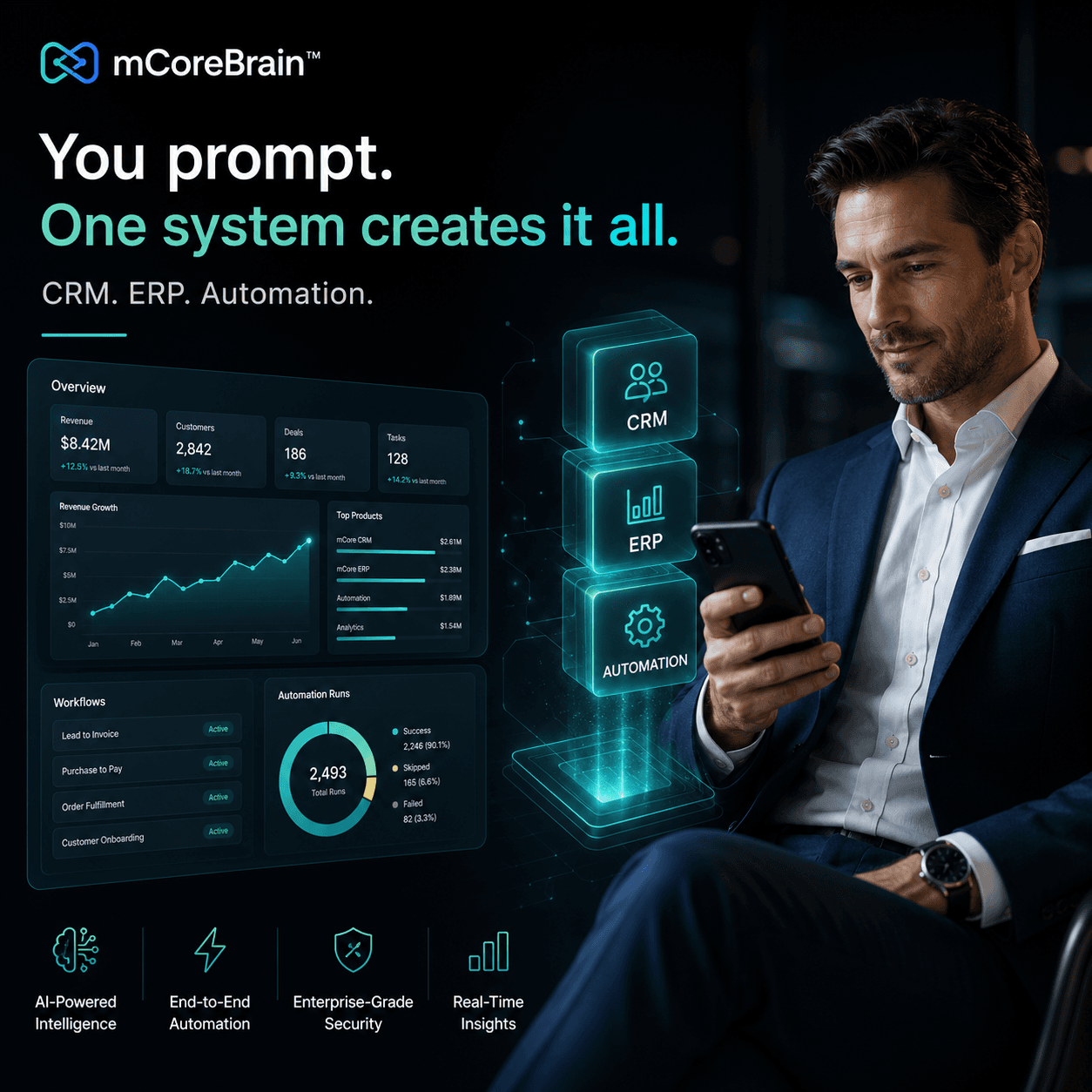
mCoreBrain lets clinical and administrative staff describe their workflows in plain language—and the system builds the CRM/ERP instantly. No code. No implementation team.
Your office manager describes the patient intake process: "When a new patient books online, send them a welcome email with forms, create a task for the front desk to verify insurance, add the appointment to our schedule, and flag the chart for the physician to review 24 hours before."
mCoreBrain generates the entire workflow, including:
- Patient intake module with custom fields for medical history, allergies, and medications
- Automated email sequences triggered by form submission
- Task assignment to specific staff roles
- Calendar integration with reminder protocols
- Role-based access so the front desk sees tasks; the physician sees flagged charts
Real Workflows, No More Spreadsheets
Imagine these scenarios working seamlessly:
Referral Management: Your clinical coordinator describes referral requests flowing from patient visits into an outbound queue, matched to insurance networks, with automated prior-auth requests. The system tracks approval status and alerts staff when letters need signing.
Follow-Up Care: Nurses need a system that reminds them to contact post-op patients at 24 hours, 1 week, and 4 weeks. mCoreBrain builds that pipeline automatically, with escalation rules if patients don't respond. No manual tickler file.
Insurance Verification: Your billing team stops calling insurance companies three times per patient. Instead, they describe the verification workflow—check active coverage, scan for pre-auth requirements, flag high-deductible plans—and mCoreBrain generates a module that either automates the check or creates a structured task with all required information.
Provider Scheduling: Block time for specific procedure types, auto-assign based on provider credentials, prevent double-booking, sync to the patient portal. One description. One system.
Governance Built In
Healthcare means compliance. mCoreBrain's two-layer architecture separates admin control from daily operations:
- Admin/Config Layer: Your practice manager and IT staff (or consultant) set policies once—data retention, access controls, audit logs, HIPAA compliance standards
- Business User Layer: Clinical and administrative staff work within those guardrails. They can customize their own workflows without breaking security or governance
Why This Matters for Staffing and Retention
Healthcare workers didn't train for 4–8 years to spend half their shift fighting software. When your team can:
- Request new workflows without waiting for IT tickets
- Get answers in hours, not weeks
- Stop doing duplicate data entry
- See patient information connected and logical
That's not soft ROI. That's reduced turnover, fewer malpractice claims, and faster patient throughput.
The Math
A typical medical practice:
- 10–15 clinical/admin staff
- 2–4 hours daily spent on manual workflows (scheduling, referrals, follow-ups, insurance, billing)
- 3–5 staff members who want new systems or features but IT backlog is 6 months deep
- Staff describe what they need (15 minutes)
- System builds it (30 minutes)
- Goes live (same day)
- All that lost time flows back to patient care
Getting Started
You don't need a CIO or a six-figure implementation budget. You need someone on your team who understands your workflows—usually your office manager, clinical coordinator, or practice administrator—to describe them to mCoreBrain in plain English.
The system does the rest.
Ready to build a CRM that works for healthcare, not against it? Visit mCoreBrain to see how prompt-native architecture eliminates implementation projects and puts control back in your team's hands. No consultants. No code. Just describe your practice, and deploy.