How Private Equity Firms Track Deals, Due Diligence & Portfolio Performance
Private equity teams juggle deal pipelines, diligence workflows, and portfolio monitoring across spreadsheets and disconnected tools. mCoreBrain lets you build a unified system in minutes—no consultant required.
Private equity is a data-intensive business. Your team tracks dozens of potential acquisitions at different stages, manages complex due diligence workflows, monitors portfolio company KPIs, and coordinates with lawyers, accountants, and operational advisors—all in parallel.
Most PE firms rely on a patchwork: Salesforce for deal flow, Excel for tracking diligence tasks, Slack for updates, Google Drive for documents, and a dozen specialist tools for portfolio monitoring. Onboarding a new analyst means three weeks learning the workflow. Closing a deal means exporting data to five different systems. A portfolio manager asking for real-time performance data means an hour rebuilding a dashboard.
This isn't just inefficient—it's risky. In due diligence, you need a single source of truth for red flags, vendor checks, and financial audits. When data lives in five places, critical information gets missed.
The PE Challenge: Complexity Across Multiple Workflows
A typical PE firm's workflow looks like this:
- Deal sourcing & pipeline: Hundreds of inbound opportunities monthly, each tracked through multiple qualification stages. You need to segment by industry, geography, size, and seller type—and reassign deals as team expertise shifts.
- Diligence management: Financial, legal, tax, operational, and commercial reviews run in parallel. Each workstream has different stakeholders, deadlines, and sign-off requirements. A single missing document can delay a 90-day process by weeks.
- Portfolio monitoring: Once you own a company, you track monthly financials, operational metrics, management changes, and exit readiness. Different stakeholders need different views (CFO wants cash flow; operational team wants efficiency metrics; founder wants governance insight).
- Team coordination: Partners, analysts, and advisors collaborate across time zones and disciplines. Information silos mean delays and duplicated effort.
Why Traditional CRM/ERP Fails PE Firms
Salesforce is built for linear sales pipelines. PE deals are non-linear, multi-threaded, and long-cycle. You spend six months building a custom Salesforce org, and it's already outdated because your firm just decided to focus on tech deals instead of healthcare.
Quick, one-off ERP systems are even worse—they're built for manufacturing or distribution, not for knowledge work that's 80% diligence and 20% execution.
What PE needs is:
- Flexibility: Your deal criteria change. Your diligence checklist evolves. Your portfolio metrics shift. You need to reshape your system in days, not quarters.
- Collaboration: Diligence is a team sport. Deal teams, advisors, and portfolio company management need to see the same workflow, same documents, same decision log.
- Real-time reporting: A partner should be able to ask "which deals are in legal review?" or "which portfolio companies missed their Q3 target?" and get the answer in seconds.
- Governance: Your fund has an audit trail requirement. Who approved this diligence finding? When was the red flag raised? This needs to be automatic, not manual.
How mCoreBrain Works for PE
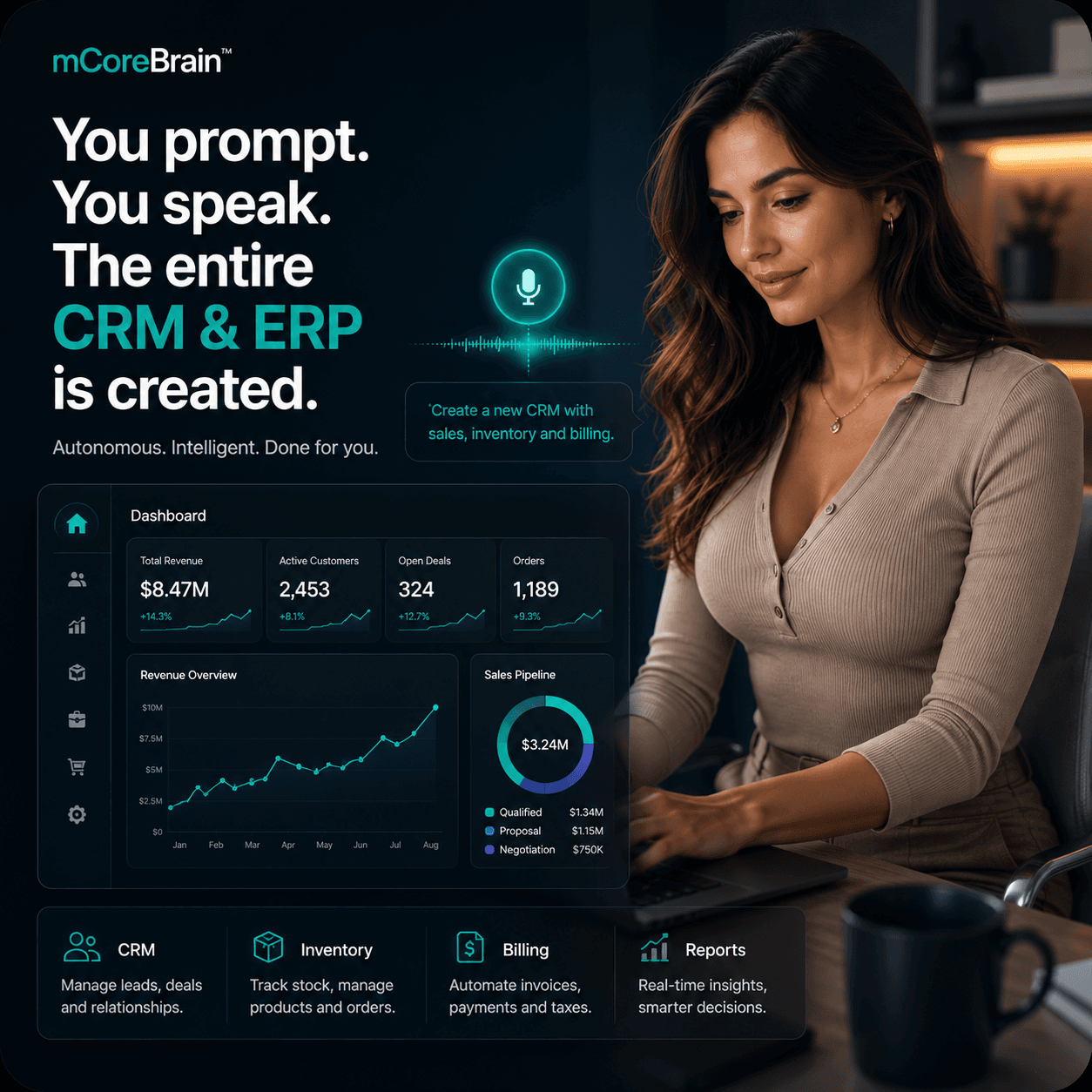
Instead of buying Salesforce + custom development + integrations, you describe your deal workflow in plain language to mCoreBrain.
"We track potential acquisitions through sourcing, qualification, LOI, due diligence, and closing. Due diligence has five parallel workstreams: financial, legal, tax, operational, and commercial. Each has its own sign-off checklist. We need role-based access so advisors only see their workstream. Portfolio companies report monthly KPIs against a custom scorecard."
mCoreBrain generates your entire system:
- Deal pipeline module: Stages, custom fields (target industry, entry multiple, strategic rationale), automated workflows (notify the deal team when moving to LOI), and built-in reporting.
- Diligence workstream: Parallel task lists for each advisor type, document trackers, sign-off gates, and automated escalations for overdue items.
- Portfolio monitoring dashboard: Monthly KPI entry by portfolio companies, variance analysis against plan, and alerts for companies off-track.
- Access control: Partners see all deals; analysts see only assigned ones; external advisors see only their workstream; portfolio company founders see only their company's page.
- Audit trail: Every change, approval, and flag is logged automatically.
When your strategy shifts (e.g., "we're now targeting founder-friendly deals"), you update your criteria in mCoreBrain's admin layer, and the business user layer adapts instantly.
Real Impact
Analysts spend less time updating spreadsheets and more time on actual diligence. Deal partners get real-time visibility without asking for status updates. Portfolio company management gets a single place to report metrics instead of emails from three different fund managers. Your audit team has a complete, immutable record of every diligence decision.
Most importantly: when a hot deal comes in and you need to spin up a deal team in 48 hours, you don't need a Salesforce project manager. Your system is already there, ready to go.
Next Steps
If your PE firm is managing deal flow and diligence across multiple tools, it's time to simplify. Visit mCoreBrain.org to see how other PE teams build unified deal systems in minutes—and deploy to production in one click. No code. No consultants. Just your workflow, automated.