How E-Commerce Brands Manage Orders, Inventory & Growth
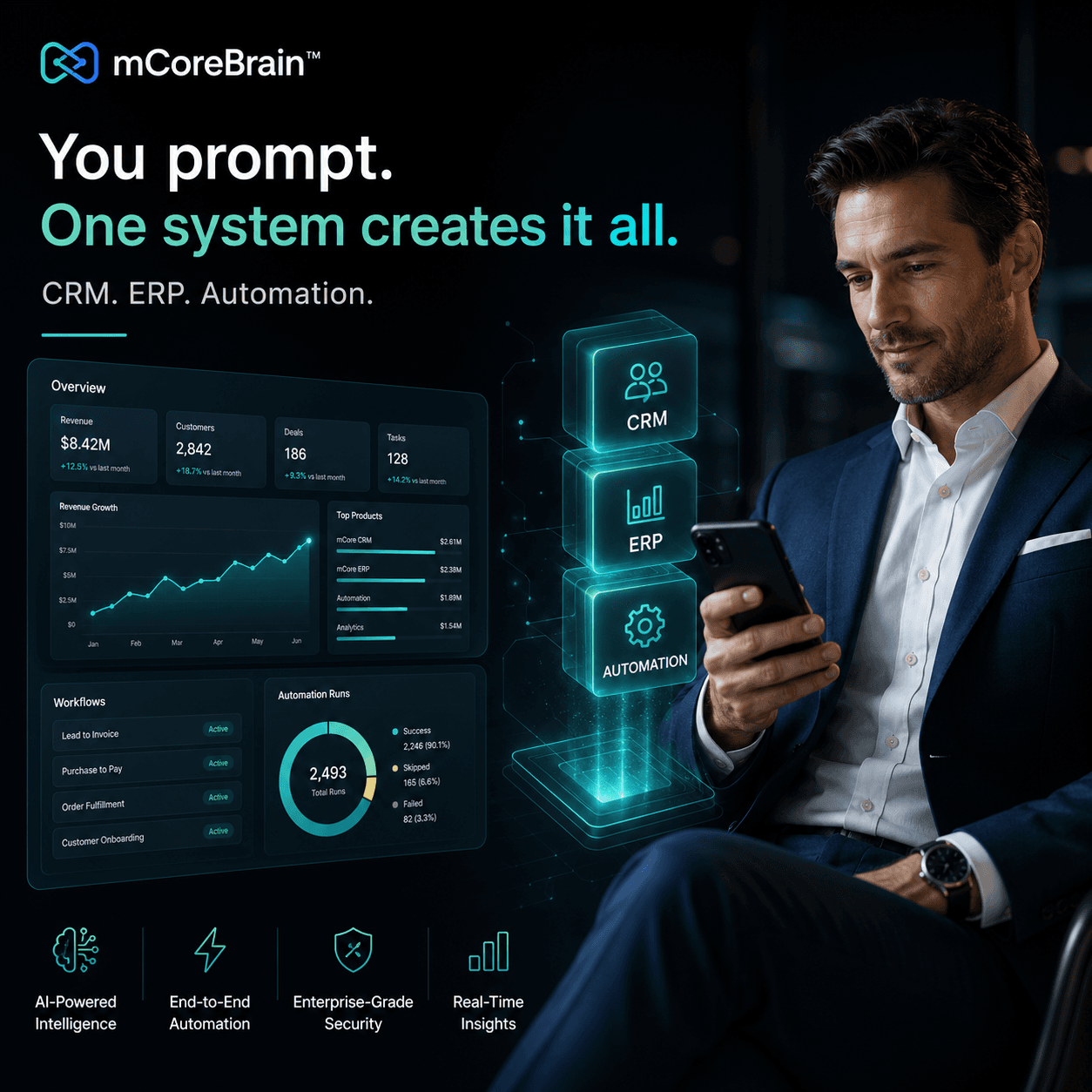
E-commerce teams juggle orders, inventory, customer data, and fulfillment across fragmented tools. mCoreBrain lets you build a unified system in minutes—no code, no consultants.
The E-Commerce Growth Trap
You started with Shopify. Then you added a separate inventory tool. Then a CRM for customer support. Then an analytics platform. Then a fulfillment dashboard. Then a marketing automation tool.
Now you have seven systems, each with partial data, none talking to each other.
This is the reality for most e-commerce teams by the time they hit $2M ARR. You're spending 20% of your engineering bandwidth on integrations. Your customer service reps are switching between three windows to answer a single email. Your inventory counts are 48 hours out of sync with your warehouse. Your marketing team can't see which customers are repeat buyers because the data lives in three places.
You're growing revenue, but you're drowning in operational complexity.
Why Traditional Systems Fail E-Commerce
Salesforce, HubSpot, and even specialized e-commerce ERPs were built for a different era. They assume:
- Rigid structure first. You define your data model in advance, then build business logic around it. But e-commerce workflows change constantly—new product types, new sales channels, new fulfillment partners.
- Integration overhead. Connecting Shopify to your ERP to your fulfillment partner to your accounting system requires middleware, API documentation, and months of custom development.
- Bloated feature sets. You're paying for CRM features you don't need, ERP modules you don't use, and support contracts that require you to hire Salesforce consultants.
- Governance complexity. Separating admin logic from business user logic is an afterthought, not architecture. By the time you need role-based access, field-level permissions, or audit trails, you're retrofitting.
The mCoreBrain Approach for E-Commerce
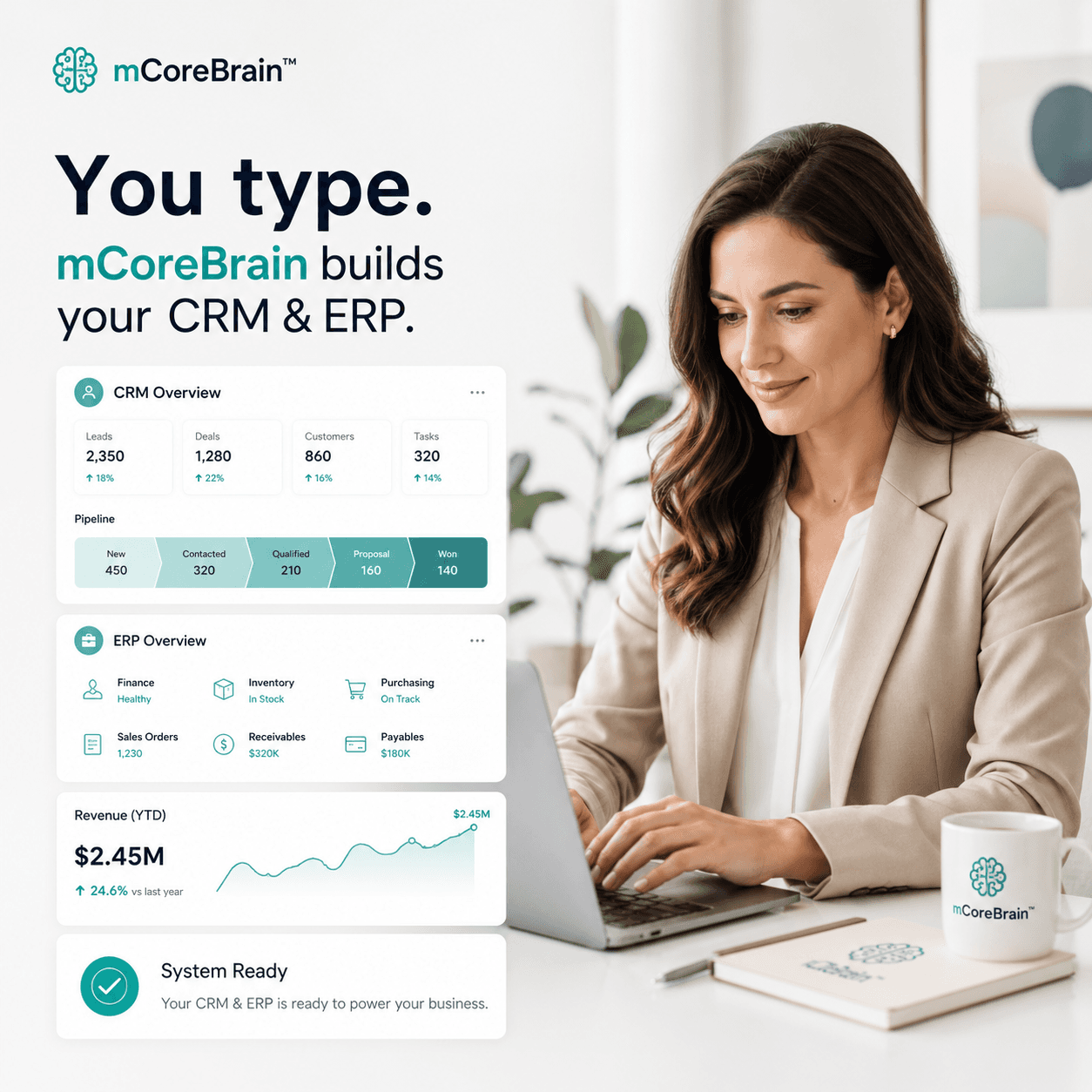
mCoreBrain inverts this model. Instead of predefined systems with hard-coded workflows, you describe your business in plain language—your products, orders, customers, inventory levels, fulfillment workflows, returns, subscriptions—and the AI generates your entire CRM/ERP in real time.
Here's what that looks like in practice:
Unified Order-to-Fulfillment Pipeline. You describe your order workflow: capture order → check inventory → route to warehouse → pack → ship → invoice. mCoreBrain auto-generates the data model, the pipeline stages, the handoff rules, and the notifications. Every team sees the same order status. No duplicate records. No conflicting data.
Dynamic Inventory Sync. Your inventory isn't a separate tool anymore—it's part of your core system. Sales order decrements stock in real time. Warehouse receives trigger reorder workflows. Low-stock alerts notify your procurement team. Returns automatically adjust quantities. One source of truth.
Customer 360 Without Data Engineering. Your customer record includes order history, lifetime value, support tickets, product preferences, email engagement, and referral status—all automatically connected. Your support team can see the full context in one view. Your marketing team can segment users by actual behavior, not guesses.
Multi-Channel Inventory Management. Selling on Shopify, Amazon, and your own direct site? mCoreBrain centralizes inventory across channels, prevents overselling, and synchronizes stock levels in real time. Your warehouse team sees all orders in one dashboard, prioritized by channel SLA or margin.
Governed Access for Rapid Scaling. As you hire—warehouse managers, customer service reps, marketing ops, finance—you need role-based access that's both secure and fast to deploy. mCoreBrain's two-layer architecture separates admin configuration (you) from business user workflows (your team). Add a new role, define permissions, deploy in minutes. No tickets to IT. No weeks of access provisioning.
The Speed & Cost Advantage
Traditional implementations of Salesforce or NetSuite for e-commerce take 4–8 months and $100K–$500K. You're writing custom code, managing data migration, training 50 people, and hoping for the best.
mCoreBrain deploys in days. You describe your business. The AI generates the schema, fields, workflows, and dashboards. You review, adjust if needed (no coding required), and deploy to production. Total time: 1–2 weeks. Total cost: fraction of enterprise software.
And it evolves. As your business changes—new sales channels, new product types, new fulfillment partners—you simply describe the change. The AI updates your system. You don't rewrite code. You don't call your vendor. You iterate.
From Tools to System
Mature e-commerce teams eventually realize that their competitive advantage isn't in tools—it's in operational efficiency. The brand that can fulfill orders in 24 hours, manage inventory across three channels, and respond to customer support in minutes wins.
that efficiency comes from having one system that reflects your actual business, not eight systems that approximate it.
Ready to Unify Your E-Commerce Operations?
If you're managing orders, inventory, and customers across fragmented tools, mCoreBrain can help you consolidate in days instead of months. Describe your business, deploy your system, and scale without the chaos.
Visit mcorebrain.org to explore how prompt-native architecture can transform your e-commerce operations.