How Logistics Coordinators Track Shipments & Cut Delays
Logistics teams drowning in spreadsheets and disconnected tools lose visibility, miss SLAs, and frustrate customers. Here's how AI-native CRM/ERP fixes it.

The Logistics Visibility Crisis
Logistics coordinators live in a nightmare of partial truths. A shipment is "in transit"—but where exactly? Is it delayed at a warehouse? Stuck in customs? The driver's phone? Critical information lives scattered across email, dispatch software, carrier portals, and handwritten notes.
When a customer calls asking "Where's my order?", the coordinator spends 15 minutes hunting through five systems to answer a question that should take 30 seconds. By then, the customer is already drafting a complaint email.
Traditional logistics platforms are built for volume, not visibility. They track shipments but ignore the business side: customer contracts, service level agreements (SLAs), profitability by lane, team performance, and the critical exceptions that demand human judgment. You're left stitching together a TMS, a CRM, a spreadsheet for financials, and a communication tool—each one blind to the others.
The result: missed SLAs, customer churn, and a team that's constantly firefighting instead of optimizing.
What AI-Native CRM/ERP Changes
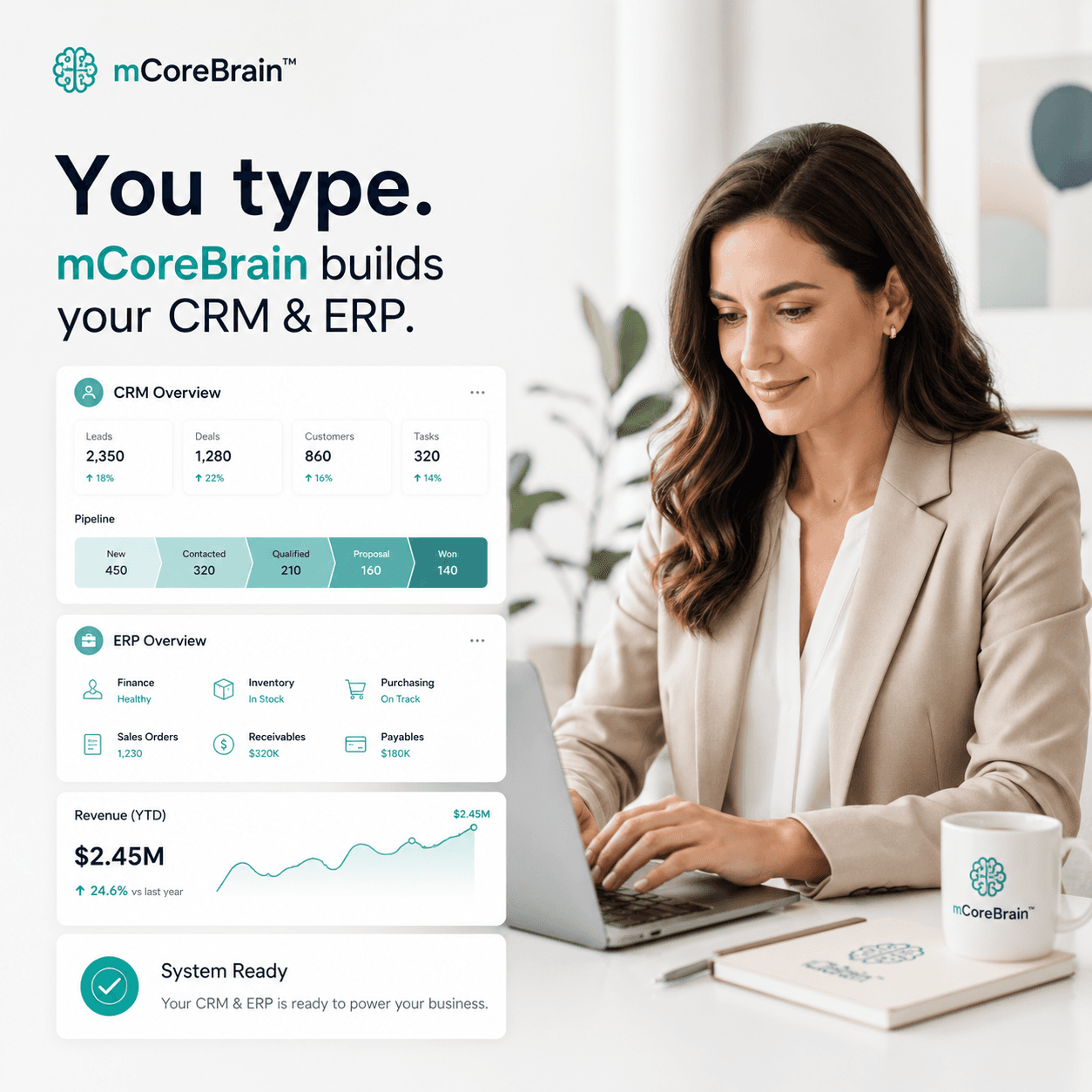
mCoreBrain eliminates the stitching problem entirely. You describe your logistics operation in plain language—your shipment types, carrier relationships, customer contracts, SLA terms, dispatch workflow, exception handling—and the system generates a unified platform instantly.
Here's what that looks like:
1. Real-Time Shipment Visibility
Every shipment exists in a single record with its full context: customer, contract terms, carrier, tracking data, pickup/delivery windows, cost, margin, and current status. No tab-switching. No calling the driver. The coordinator sees the whole picture and can instantly flag delays, route exceptions, or at-risk deliveries.2. Automated SLA Tracking
You define SLAs once—"domestic ground within 5 days," "international air within 10 days," "white-glove delivery by appointment." The system automatically tracks every shipment against its SLA and flags exceptions before they breach. A coordinator gets an alert at hour 4 of a 5-day window if a shipment isn't moving, not a complaint call at hour 72.3. Customer Contract Intelligence
Your pricing, service terms, and exceptions live tied to each customer record. When a rush order comes in, the system instantly knows that customer's rate card, lead-time requirements, and special handling needs. No negotiation paralysis. The coordinator confirms the order in minutes.4. Profitability Per Lane, Per Customer
Traditional logistics tools track volume. mCoreBrain tracks profit. You see which customers are truly profitable, which lanes are margin killers, where you're absorbing cost. A coordinator can instantly tell a sales rep, "We can do that lane, but at this rate," instead of guessing.5. Exception Management Workflows
Not every delay is a disaster. Weather delays, carrier capacity, customs holds—each has different protocols. You define workflows for different exception types. When the system detects an exception, it routes to the right team (dispatch, customer service, finance) with full context and predetermined next steps. No more confused group emails.6. Carrier Performance & Capacity Planning
You track every carrier's on-time rate, damage rate, and cost per lane. Over time, the system shows you which carriers are reliable, which ones you're overloading, and where capacity gaps exist. You make smarter carrier decisions instead of reactive ones.The Practical Impact
For coordinators: No more system hopping. One interface, full context, 10x faster response to customer inquiries.
For management: Real visibility into SLA performance, profitability, and team capacity. You know where delays happen and why—not after the fact, but as they're happening.
For customers: Orders feel tracked and predictable. When a delay happens, you're calling them with a solution before they call you with a complaint.
For hiring: New coordinators get trained on one system instead of four. Onboarding is weeks faster.
How It Works
You don't describe your entire logistics operation in a single prompt. Instead:
- Week 1: You describe your core workflow—shipment intake, assignment, tracking, delivery confirmation, exception handling.
- mCoreBrain generates: Data model, screens, workflows, dashboards, integrations with carriers and TMS systems.
- Week 2: You refine SLA rules, customer contract terms, exception protocols, and reporting.
- mCoreBrain regenerates: Updated system with your governance rules baked in.
- Deploy to production: With one click, your team is live.
Why This Matters Now
Logistics companies are under siege from e-commerce speed expectations and razor-thin margins. You can't compete on price alone. You compete on reliability, speed of visibility, and exception handling. mCoreBrain is built exactly for that.
Traditional platforms are sprawl. mCoreBrain is unified, adaptive, and built on what your team actually needs to know.
Ready to unify your logistics operations? Visit mcorebrain.org to describe your shipment workflow and deploy your logistics CRM/ERP in days, not months.