How Private Medical Practices Scale Patient Care Without System Sprawl
Private medical practices face chaos as they grow: patient records in one system, billing in another, scheduling in a third. mCoreBrain unifies it all in hours, not months.

The Private Practice CRM/ERP Problem
Running a private medical practice means juggling competing priorities: patient care, revenue cycle management, staff scheduling, compliance, and growth. Yet most practices operate across 5–7 disconnected systems.
Patient records live in one EMR. Billing runs through a separate system. Appointment scheduling is scattered across a calendar app. Patient communications happen via text or email. Insurance authorizations are tracked in spreadsheets. Staff roles and access are managed manually.
When a patient calls with a billing question, your front desk searches three systems to find the answer. When a provider needs to check a patient's history before an appointment, they log into the EMR, then the billing system, then the portal. When revenue leaks because claims aren't tracked, nobody knows where the breakdown is.
The result: delayed patient care, lost revenue, staff burnout, and compliance risk.
Why Traditional Medical Software Fails
You've probably considered enterprise ERP or medical-specific platforms. Here's what happens:
- Months of setup. Implementation consultants spend 6–12 weeks building your workflows, mapping fields, configuring integrations. Your practice pays $50K–$200K+ in services.
- Rigid structures. The software forces your practice into pre-built workflows. If your processes don't match the template, you either adapt your practice or pay extra for customization.
- Training overhead. Staff need weeks of training to learn yet another system. Adoption is slow; error rates stay high.
- Ongoing maintenance. When regulations change or your practice evolves, you file tickets with the vendor and wait for updates. You can't adjust workflows yourself.
- Integration hell. Your EMR won't talk to your billing system. Your scheduling tool doesn't sync with your revenue cycle. Data is duplicated and out of sync.
The mCoreBrain Approach
mCoreBrain is built for exactly this scenario: businesses that need structure and governance, but can't afford months of implementation and rigid software.
Here's how it works for a private medical practice:
1. Describe your practice in plain language. You tell mCoreBrain: "We manage patient appointments, track insurance authorizations, bill patients and insurance, record visit notes, manage staff roles, and track revenue." You don't code. You don't build ERDs. You describe your business.
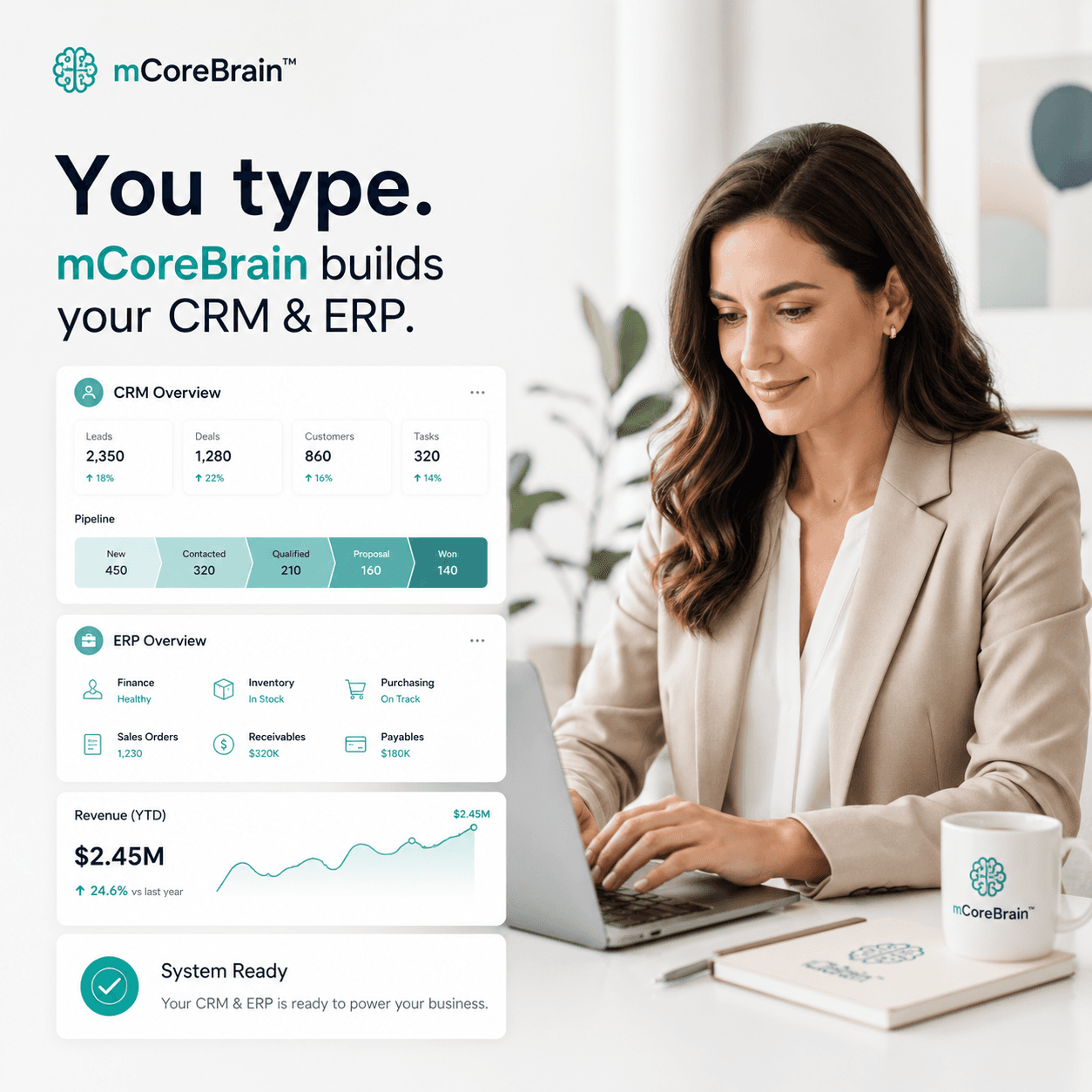
2. AI generates your complete system in real time. mCoreBrain's AI instantly builds:
- A patient module with demographics, medical history, insurance details, and communication preferences
- An appointment scheduling module with provider calendars, room availability, and automated reminders
- A revenue cycle module tracking authorizations, claims, patient balances, and payments
- A visit documentation module for clinical notes and treatment history
- Role-based access controls so providers see clinical data, billing staff see financial data, and front desk manages scheduling
- Workflows for appointment confirmation, claim submission, and payment posting
- Dashboards showing no-shows, claim aging, revenue by provider, and patient demographics
4. Adjust in real time—no code required. When you want to add a field (e.g., "preferred communication method"), you describe it in plain language and the AI regenerates your system. When a new insurance requirement comes down, you update your workflows without tickets or waiting.
Real Benefits for Private Practices
- Unified patient view. A patient's appointment history, billing, clinical notes, and insurance details are all in one place. No more switching between systems.
- Revenue integrity. Claims are tracked end-to-end. You see bottlenecks immediately (e.g., authorizations pending, claims rejected, payments delayed).
- Compliance by design. Role-based access ensures HIPAA compliance. Audit trails are automatic. Staff can only see data they need.
- Faster appointments. Automated reminders, online scheduling, and pre-visit documentation mean less time on admin and more time with patients.
- Staff ownership. Your billing manager, front desk, and clinical team can adjust workflows themselves. No waiting for the vendor.
- Scalability without chaos. As you add providers, locations, or services, your system grows with you—not against you.
Why This Matters
Private practices are the backbone of healthcare. They compete with large hospital systems and urgent care chains by offering personalized care and trust. But operational inefficiency undermines that advantage. When patients can't easily schedule, get bills right, or access their records, they leave.
mCoreBrain lets you compete on care quality, not IT overhead. Your team focuses on patients. Your systems work for you, not against you.
Get Started
If you're running a private practice and tired of system sprawl, visit mcorebrain.org to see mCoreBrain in action. Describe your practice, watch your system generate in real time, and deploy it to production today. No consultants. No months of waiting. Just a working CRM/ERP that grows with your practice.