How Staffing Agencies Scale Without Fragmented Tools
Staffing agencies juggle candidates, placements, client relationships, and payroll across five or more disconnected systems. mCoreBrain replaces the chaos with one AI-generated platform.

The Staffing Agency Juggling Act
Staffing and recruitment agencies operate in controlled chaos. On any given day, your team is:
- Managing hundreds of active candidates across different skill levels and availability
- Tracking open requisitions from multiple clients with varying requirements
- Negotiating placement terms, rates, and contract lengths
- Scheduling interviews and managing offer pipelines
- Processing payroll and timesheets for placed staff
- Chasing invoice payments from clients
- Maintaining compliance documentation for each placement
The result? Data lives in silos. Your sales team doesn't see payroll issues. Your operations team re-enters candidate data. Your finance team manually reconciles invoices. Nobody owns the full picture.
Where Traditional Systems Fail
A typical staffing agency CRM or ATS is built for one workflow: either recruiting or client relationship management, rarely both seamlessly.
ATS platforms excel at candidate tracking and interview workflows—but treating clients as secondary. They don't handle invoicing, contract management, or multi-entity payroll.
CRM platforms are built for sales pipeline management. They don't understand the nuances of candidate lifecycle, placement logistics, or staffing-specific compliance needs.
ERP systems (SAP, Oracle NetSuite) can theoretically do everything, but cost $100K+ to implement, require consultants for 6+ months, and demand custom code for staffing-specific logic. They're built for manufacturing and retail, not the speed and flexibility staffing demands.
So agencies end up paying three vendors, managing three integrations that break monthly, and training staff on three different user experiences.
What mCoreBrain Changes
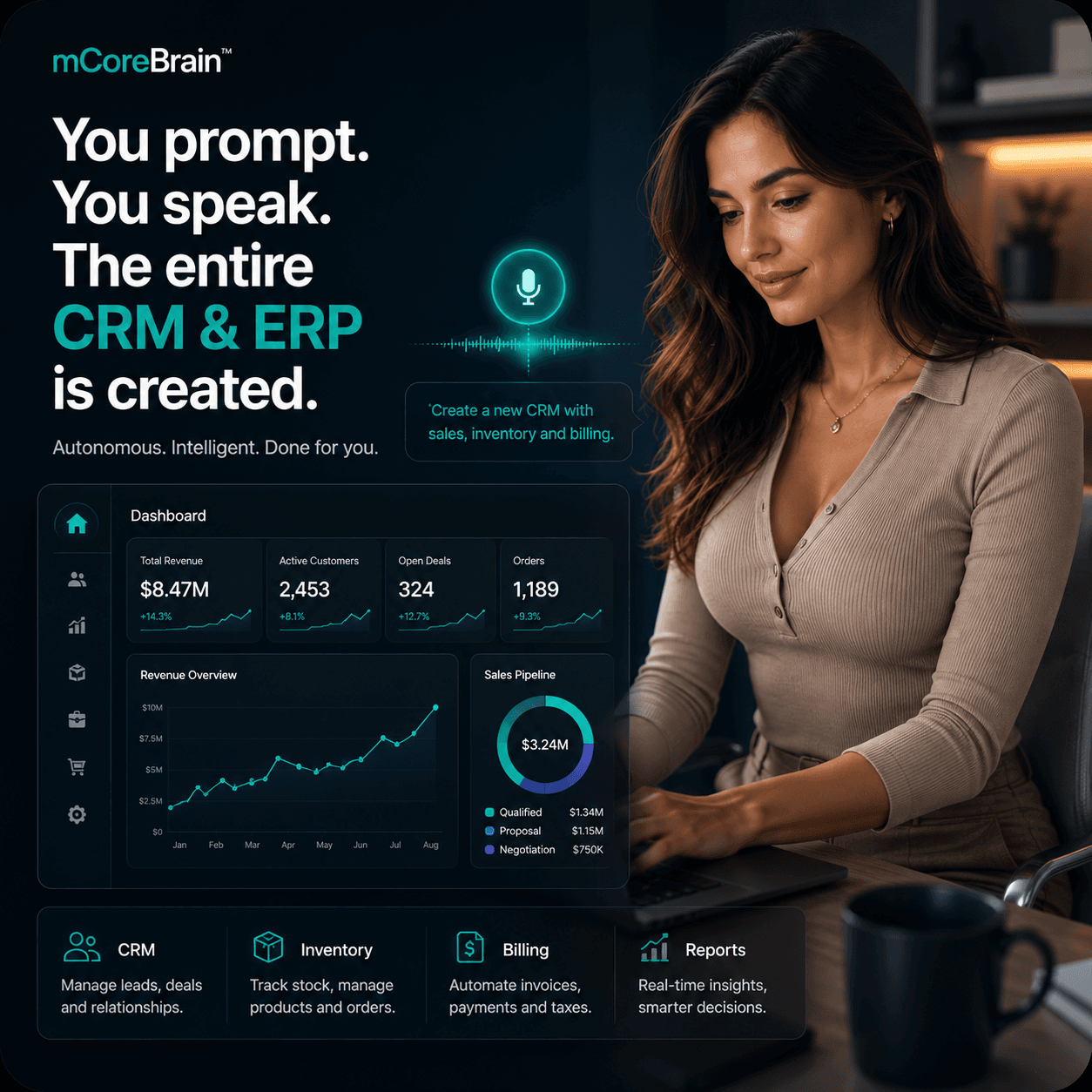
mCoreBrain lets you describe your staffing operation in plain language — and the AI generates a purpose-built CRM/ERP in minutes.
You might say:
"I need to track candidates with their skills, certifications, and availability. I need clients with open roles, rates, and contract terms. When I place a candidate, I need to generate an assignment with dates, markup, and auto-generate timesheets every Friday. I need invoices to pull from assignments. And I need role-based access so recruiters see candidates, account managers see clients, and finance sees invoices only."
The platform generates the entire data model, workflows, roles, and dashboards instantly. No code. No consultant. Deploy to production same day.
For a staffing agency specifically, this means:
- Unified candidate database with skills matrix, availability calendar, certification tracking, and placement history—all in one place
- Client management with contact roles, open requisitions, rate cards, and contract templates
- Assignment lifecycle from placement through staffing, timesheet capture, invoicing, and payment tracking
- Payroll integration (or native payroll workflows) that pulls hours from timesheets and auto-calculates payouts
- Compliance tracking with audit logs, consent records, and customizable legal holds per placement type
- Multi-user governance so recruiters, account managers, finance, and ops each see only what they need
- Real-time dashboards showing open roles, placement pipeline, time-to-fill, margin by client, and cash flow
Concrete Example: A Placement Workflow
Here's how it works in practice.
A new client request comes in: they need a contract software engineer, 6-week assignment, $85/hour, start Monday. Your recruiter:
- Creates an Assignment in mCoreBrain and links it to the client and open role
- Searches the candidate database for matching skills and availability
- Sends an offer with the rate, duration, and start date
- Candidate accepts; assignment auto-moves to "Active"
- Every Friday, the platform auto-generates a timesheet form for the candidate to log hours
- Candidate submits 40 hours; invoice auto-generates to the client (pulling their rate card: 40 × $85 = $3,400)
- Payroll calculation auto-generates for the candidate (40 × $60 internal cost = $2,400)
- Margin tracking shows $1,000 profit on this placement
- Finance reviews and approves the invoice with one click
- Client is invoiced; candidate is paid; both are logged for compliance
Why This Matters for Growth
As you scale from 50 to 500 active placements, adding a new tool is no longer feasible. Your team doesn't have time to re-key data. Your finance team can't manually reconcile invoice-to-payroll anymore. Your data becomes a liability, not an asset.
mCoreBrain eliminates that constraint. You describe your process once. The AI adapts as you grow. Want to add a new placement type? Add a client segment? Support a new currency? Describe it, and the system evolves in minutes—no developer needed.
Ready to Unify Your Staffing Operation?
If your team is scattered across ATS + CRM + payroll + invoicing, it's time to consolidate. Visit mCoreBrain.org to see how AI-native infrastructure can replace your entire tool stack with one coherent system. Describe your staffing workflows, deploy in hours, and reclaim your team's time.