How Construction Firms Bid & Track Projects Without Tool Chaos
Construction companies juggle estimates, timelines, budgets, and crew schedules across scattered tools. mCoreBrain lets you manage the entire project lifecycle in one AI-native system.

The Construction CRM Problem
Construction firms live between two worlds: the front-end complexity of sales (managing leads, bid requests, competitive estimates) and the operational intensity of execution (crew scheduling, material tracking, budget monitoring, change orders). Most try to solve this with a patchwork of tools—a CRM for leads, a project management platform for execution, spreadsheets for estimates, accounting software in the corner, and phone calls tying it all together.
The result? Bid data that doesn't sync with project schedules. Budget overruns discovered too late. Crew assignments that conflict with material delivery dates. Client communication fragmented across email, text, and portals. And margins eroding silently because no one has a real-time view of labor costs against contract value.
Traditional CRM and ERP platforms weren't built for construction's rhythms. They're too rigid, require months to configure, and force you to hire consultants just to add a custom field. By the time they're live, your business processes have already changed.
Why mCoreBrain Changes the Game for Builders
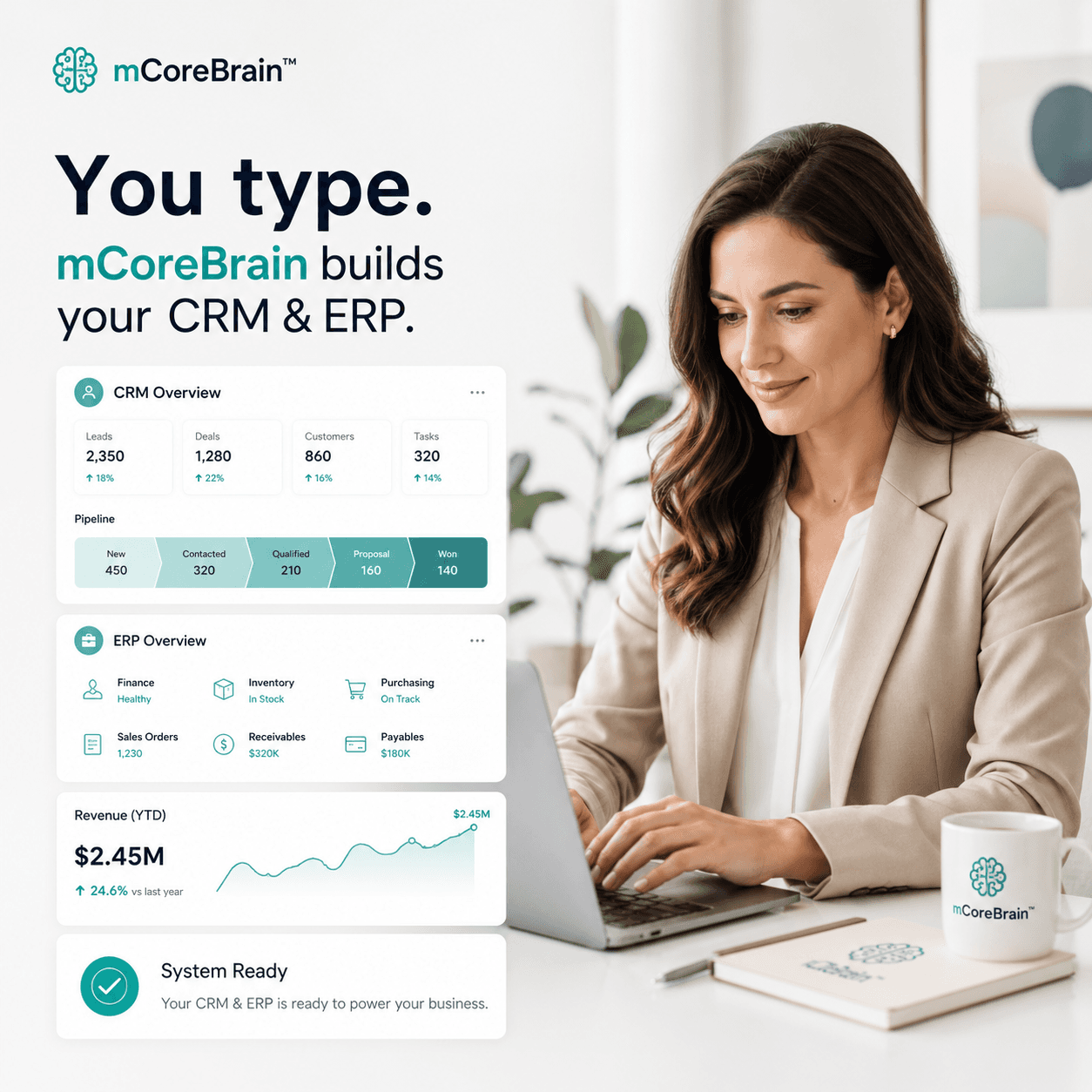
mCoreBrain's prompt-native architecture means you describe your construction workflow in plain language, and the system generates the exact CRM and ERP you need—in minutes, not months.
No more compromises. No more "that's not how we work, but we'll adapt." You tell mCoreBrain:
- How you track leads and generate estimates
- What fields your bid documents require
- How crews are assigned and scheduled
- Which budget variances trigger alerts
- Who approves change orders and why
- How you forecast project profitability
What a Real Construction Workflow Looks Like in mCoreBrain
Sales & Bidding Phase: A new bid request arrives. Your estimator logs it into mCoreBrain, and the system auto-populates standard fields (project size, location, client type, timeline). They upload site photos and specifications; the system flags similar past projects for benchmarking. They build the estimate, and mCoreBrain calculates material takeoffs, labor hours, and profit margins—all validated against your historical cost database.
Once the bid is submitted and won, one click converts it into a live project with a budget, schedule, and resource plan already initialized.
Execution Phase: Project managers assign crews and track progress. Timesheets feed directly into labor cost tracking. Material deliveries are logged and matched against the budget. If actual labor hours or material costs deviate by more than a threshold, the system alerts the PM and finance team—before small problems become big ones.
Change orders are captured in-system, routed to the client and PM for approval, and automatically roll into the updated budget and schedule.
Billing & Closeout: When a milestone is reached, billing is generated automatically from approved time and materials. Profitability is calculated in real time, not weeks later via spreadsheet archaeology. Lessons learned are logged and tagged for future estimating.
The Governance Layer That Protects You
Construction firms need different people to see different things. A crew lead doesn't need to see the bid margin; an estimator shouldn't approve crew overtime; finance shouldn't assign work.
mCoreBrain's two-layer architecture separates config (what admin/estimators set up) from business operations (what PMs, crews, and finance actually use). This means:
- Accurate cost tracking without accidentally exposing profit margins to crews
- Role-based dashboards: estimators see win rates and margin trends; PMs see schedule and budget health; crews see their daily assignments
- Audit trails for compliance (important for contract disputes and insurance claims)
- One source of truth, no shadow spreadsheets undermining governance
Speed & Scalability Without Consultant Fees
A traditional ERP implementation for a mid-sized construction firm takes 6–12 months and costs six figures. You configure modules, hire integration experts, run pilots, retrain staff.
With mCoreBrain, you're live in days. A small construction firm can deploy it immediately. A regional builder with 50 projects can scale it to 500. And when your process changes (new client types, new markets, new crew structures), you update your prompt and redeploy—in hours, not months.
There's no vendor lock-in either. Your data is yours, your workflows are yours, and you can export everything at any time.
The Real Win: From Chaos to Control
Construction is a thin-margin business. Every percentage point of waste—labor inefficiency, material overage, delayed billing, overlooked change orders—compounds across dozens of simultaneous projects.
mCoreBrain doesn't just organize chaos. It creates visibility, enforces discipline, and lets you make faster, smarter decisions. Your team stops fighting tools and starts running the business.
Ready to replace your construction CRM and project management sprawl with one AI-native system? Visit mCoreBrain.org to describe your workflow and generate your custom CRM/ERP instantly. No code, no consultants, no months of waiting.