How SaaS Sales Teams Close Deals Without CRM Bloat
SaaS sales leaders waste 40% of their week on admin work. mCoreBrain eliminates that overhead—build your exact sales system in minutes, not months.

The SaaS Sales Problem: Too Many Tools, Too Little Visibility
SaaS sales teams live in a constant state of tool fragmentation. You need a sales pipeline tracker, but Salesforce's sprawl means your team spends hours updating records that no one reads. You bolt on Slack integrations, Zapier workflows, Gong for call insights, HubSpot for marketing sync—and suddenly you have six "sources of truth" that contradict each other.
The real cost? Your AEs are buried in admin. They're updating deal stages in Salesforce, logging calls in a separate system, tracking follow-ups in Slack threads, and exporting data to Sheets for forecast meetings. By Friday, nobody knows which deals are actually moving.
Traditional CRMs force you to fit your business into their rigid data model. SaaS teams don't all work the same way—your PLG motion is different from your enterprise sales cycle, which is different from your partner channel. You end up with Salesforce implementations that took 6 months and $200k, serving nobody well.
What a SaaS Sales System Should Actually Do
Your CRM should reflect your deal process, not force you into theirs:
- One source of truth for pipeline: Every deal, every stage, every customer conversation—visible to your whole team in real time.
- Automatic data capture: Emails, meeting notes, Slack messages—all tied to accounts and opportunities without manual entry.
- Flexible workflows for different motion types: Enterprise deals move through negotiation → contract → legal; self-serve leads move through trial → onboarding → expansion. One system should handle both.
- Role-based visibility: Your VP of Sales sees forecast by segment. Your AE sees their own pipeline. Your finance team sees revenue recognition. No spreadsheet exports needed.
- Frictionless forecasting: Real-time dashboards, not monthly Sheets updates that are out of date the moment they're sent.
- Buy Salesforce and pay consultants $100k+ to bolt it into their workflow (takes 6+ months)
- Use lighter tools like HubSpot and lose advanced features as they scale
- Frankenstein together 5–10 point solutions and die a death by Zapier
How mCoreBrain Fixes This
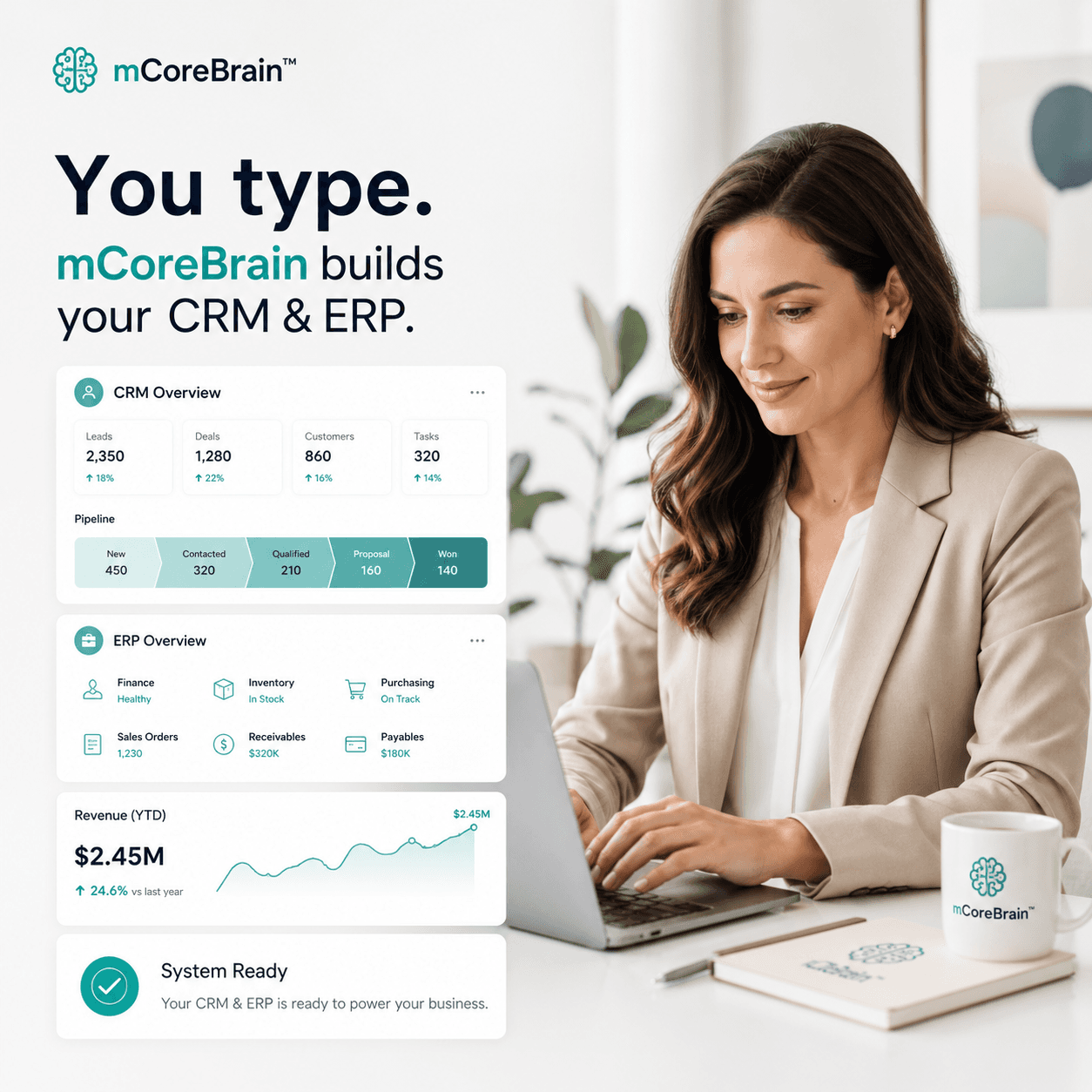
mCoreBrain is prompt-native, meaning you describe your sales process in plain language—and the system builds itself.
Here's what that looks like in practice:
Step 1: Define Your Process Your CRO describes your sales motion: "We have three tracks—enterprise on a 6-month cycle, mid-market on 3 months, and SMB self-serve. Enterprise deals need approvals and legal review. Mid-market are inside sales. SMB is fast-tracked through trial."
mCoreBrain generates the entire data structure: account and opportunity records, custom fields for each motion type, approval workflows for enterprise deals, automated trial-to-paid workflows for SMB.
Step 2: Configure Governance Your admin sets up two-layer access:
- Config layer: CRO and sales ops can modify fields, stages, and workflows
- Business layer: AEs see their pipeline, close deals, and log activity—no configuration access
Step 3: Deploy to Production One click. Your CRM is live. No 6-month implementation. No "go-live" disaster. Your team starts using it today.
Real Advantages for SaaS
Faster iteration: Your sales process isn't static. If you discover that enterprise deals need a "vendor due diligence" stage, add it in minutes—not weeks of consulting tickets.
No over-engineering: You're not paying for Salesforce features you'll never use. mCoreBrain builds exactly what you need.
Automatic integrations: Email, calendar, and Slack sync work out of the box. No Zapier setup, no webhook debugging.
Mobile-first for reps: Your AEs can update deals, log calls, and check forecasts from anywhere—built for how modern sales teams actually work.
Scalable structure: As you add regions, segments, or products, your system scales with you. The two-layer architecture keeps your config clean even as your business gets complex.
The Bottom Line
SaaS teams deserve better than choosing between Salesforce's bloat or HubSpot's limitations. You should have a CRM that matches your sales process exactly—built in days, governed properly, and deployed without drama.
That's what mCoreBrain does. Describe your sales motion. AI generates your CRM. Deploy in one click.
Ready to replace your sales tool sprawl? Visit mCoreBrain.org and generate your first system today—no code, no consultants, no months-long implementation.